




Cramps that double you over. A wave of nausea. An ache spreading into your back and thighs before you’ve even started bleeding. A painful period touches nearly every part of your body, not just your uterus, and that’s not in your head.
The chemical driving your cramps, prostaglandin, is also behind a lot of the back pain, diarrhea, and exhaustion people describe alongside their period. Doctors call this dysmenorrhea, and it affects up to 90% of people who menstruate, according to the American College of Obstetricians and Gynecologists (ACOG).
This guide covers why period pain spreads the way it does, what actually helps, why one person’s go-to pain reliever can do nothing for someone else, and the signs that mean it’s time to call a doctor.
What Causes Period Cramps (Dysmenorrhea)?
Period cramps happen when your uterus contracts to shed its lining, triggered by hormone-like chemicals called prostaglandins; the more your body releases, the harder the contraction and the more it hurts.
Prostaglandin levels peak on day one of your period and drop as bleeding continues, which is why cramps usually ease by day 2-3. Pain with no underlying condition behind it is called primary dysmenorrhea, and it typically starts within a year of your first period.
Secondary dysmenorrhea is different: Pain caused by an underlying issue, most often endometriosis, along with adenomyosis or fibroids. It tends to worsen as your period goes on, can show up other times of the month too, and is worth raising with a doctor rather than managing alone.
Why Do Cramps Spread to Your Back, Hips, or Legs?
Prostaglandins don’t stay in your uterus. They trigger contractions in nearby muscle and travel along nerve pathways your pelvis shares with your lower spine, which is why cramping so often radiates into your lower back, hips, and thighs.
This is one of the most common dysmenorrhea symptoms, reported right alongside the cramps themselves, usually a dull, deep ache that peaks on day one and fades with the rest of the cramps.
Heat works well here because it targets the actual mechanism: warmth relaxes contracted muscle and increases local blood flow, easing the referred pain along with the cramp. Back pain paired with nausea or vomiting, or pain that ibuprofen doesn’t touch, is worth mentioning to a doctor.
Why Does Your Period Cause Nausea, Diarrhea, or “Period Flu”?
The same prostaglandins that contract your uterus act on your gut too, which is why nausea, loose stools, headaches, and even a low-grade fever can show up right alongside your cramps.
Some people call this cluster “period flu.” It isn’t an actual virus; it’s prostaglandins circulating beyond your uterus, plus the drop in estrogen and progesterone that happens right before your period, according to Cleveland Clinic. Both can leave you feeling achy and drained days before you even start bleeding.
For most people, these symptoms track the same timeline as the cramps: worst on day one, better within a couple of days. Severe vomiting, won’t let you keep fluids down, or lasts beyond your first day or two is different; that’s a reason to call your doctor rather than wait it out.
Why Doesn’t the Same Pain Reliever Work for Everyone?
NSAIDs like ibuprofen and naproxen are the first-line treatment for period pain because they block prostaglandin production directly. But research shows they bring little to no relief for roughly 1 in 5 people who try them, and part of that gap can come down to genetics, not effort or dosing.
Ibuprofen and several other common NSAIDs (naproxen, celecoxib, meloxicam) are broken down largely by a liver enzyme called CYP2C9. Depending on which version of that gene you carry, your body can clear these medications faster or slower than a standard dose assumes: slower metabolism means the drug stays active longer and side-effect risk climbs at a “normal” dose, while faster metabolism can mean the relief wears off before your cramps do. The Clinical Pharmacogenetics Implementation Consortium (CPIC) publishes prescribing guidance built around exactly this variation.
One tip that helps regardless of genetics, straight from ACOG: NSAIDs tend to work best when you start them a day or two before your period, not after the pain has already peaked.
This is where pharmacogenomic (PGx) testing earns its place in the conversation. A PGx panel like the one RPh Labs runs from a simple cheek swab checks CYP2C9 and dozens of other genes against your actual medication list, so you and your provider aren’t left guessing which reliever, or which dose, fits your biology. You can check whether your usual pain reliever is on RPh Labs’ tested medication list.
What Actually Helps Relieve Period Cramps?
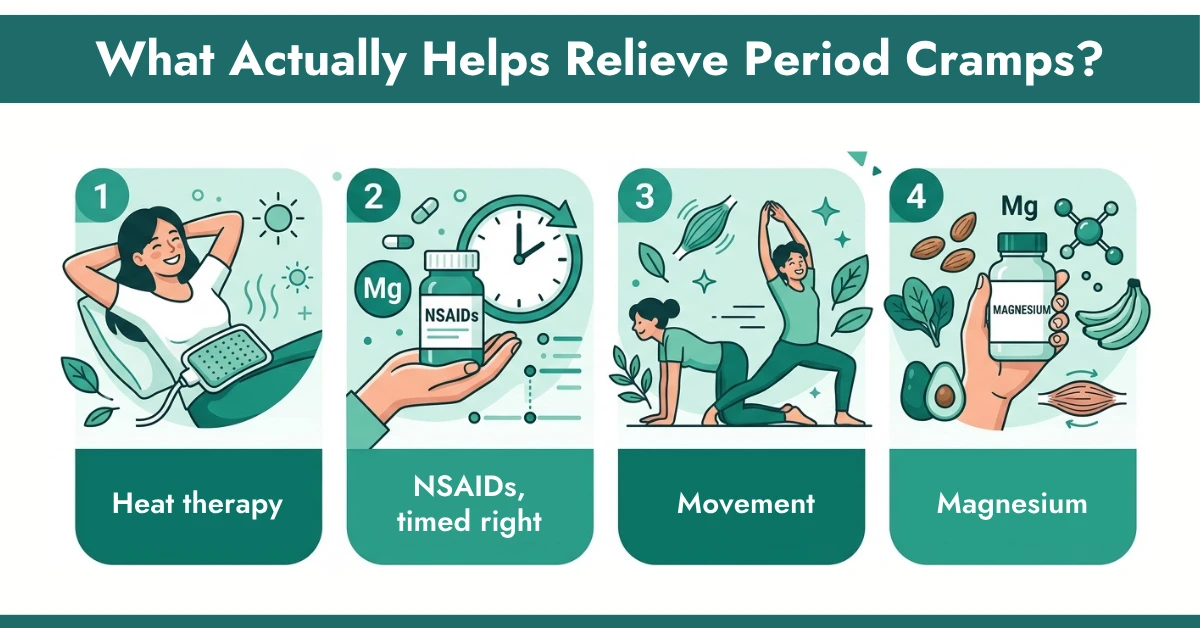
Heat, correctly timed NSAIDs, and steady movement have the most research behind them, and heat performs better than most people expect.
- Heat therapy: In randomized trials, a heating pad on the lower abdomen worked as well as ibuprofen for period pain, with one study finding relief arrived faster. 20 minutes a couple of times a day is the typical dose researchers test.
- NSAIDs, timed right: Starting a day or two before your period, rather than after cramps peak, tends to work better; prostaglandins are easier to block before levels spike than after.
- Movement: Light activity like walking or stretching eases cramp intensity for most people, even when it’s the last thing you feel like doing.
- Magnesium: Several clinical reviews link regular magnesium intake to milder cramps over time, likely from its effect on muscle relaxation.
It isn’t instant relief; ask your pharmacist whether it fits alongside anything else you take.
If your entire routine leans on one pain reliever and it’s still not enough, that’s worth digging into rather than pushing through it every month.
When Are Period Cramps a Sign of Something More?
Most period pain is uncomfortable, not dangerous. But pain that’s sudden, severe, or clearly different from your usual pattern is your body telling you to get checked instead of waiting it out.
| Usually just period pain | Talk to a doctor promptly |
| Cramping that starts a day or two before your period, eases by day 2-3. | Pain that’s sudden, severe, or unlike your usual cramps. |
| Mild-to-moderate back, hip, or thigh ache. | Fever, fainting, or feeling like you might pass out. |
| Some nausea, loose stools, or bloating. | Heavy bleeding (soaking a pad or tampon within an hour), or large clots. |
| Pain that eases at least partly with heat or NSAIDs. | Pain that keeps getting worse cycle after cycle, or stops responding to treatment. |
| Symptoms that resolve within a few days of your period starting. | New pelvic cramping after menopause, or severe pain with any chance of pregnancy. |
Sudden, one-sided pain, especially with fever or vomiting, needs prompt evaluation to rule out causes like appendicitis or an ovarian cyst, not a home guess. Pain that sits higher up, closer to your ribs or kidneys than your pelvis, is also worth mentioning, since it may not be period-related at all. Chest pain or shortness of breath are never typical period symptoms, on your cycle or off it; treat those as reasons to get checked right away.
How Is Dysmenorrhea Diagnosed & Can Genetic Testing Help?
Most doctors diagnose dysmenorrhea from your symptom history and a physical exam. If pain doesn’t improve with NSAIDs or hormonal treatment after a few months, your doctor may order a pelvic ultrasound to check for endometriosis, fibroids, or adenomyosis before looking further.
A PGx test doesn’t replace that workup; it adds to it. RPh Labs’ at-home PGx kit checks how your body processes 240+ medications from one cheek swab, with results delivered through your secure portal in 7-10 business days. Here’s exactly how the process works, along with the insurance and payment options available if you’d rather not pay the full cost out of pocket.
A PGx result is one input your provider weighs alongside your history, not a stand-alone diagnosis, and not a guarantee of pain relief.
Conclusion:
Period pain that derails your month deserves more than “take ibuprofen and wait it out.” For most people, correctly timed NSAIDs, heat, and movement cover it. For the roughly 1 in 5 whose usual pain reliever barely makes a dent, genetics may be a piece nobody’s checked yet.
RPh Labs’ PGx test checks CYP2C9 and dozens of other genes against 240+ medications, from a cheek swab you can do at your kitchen table. See if your state is covered, or check which medications are on the list before you order.
Disclaimer:
This article is educational and isn’t a substitute for individualized medical advice. Talk with your doctor or pharmacist about any symptoms that worry you.
Frequently Asked Questions
Yes. Prostaglandins act on your digestive tract the same way they act on your uterus, which is why loose stools and nausea are common alongside cramps. Vomiting that’s severe or won’t let you keep fluids down is different, and worth a call to your doctor.
Dysmenorrhea is coded N94.6 when the cause isn’t specified. If a provider has documented a specific cause, you may instead see N94.4 (primary dysmenorrhea) or N94.5 (secondary dysmenorrhea) on your chart.
Yes, ovulation, early pregnancy, and other causes unrelated to your uterus can all produce period-like cramps. If pregnancy is possible and the pain is severe or one-sided, contact a doctor promptly rather than waiting to see if your period starts.
A PGx test shows how your body metabolizes certain medications, including some NSAIDs, real information instead of a guess. It’s one input among several, not a guarantee of relief or a replacement for medical advice.
Rectal or anal pain during your period is usually caused by uterine contractions and prostaglandins irritating nearby nerves and pelvic muscles. Severe or recurring pain may be a sign of endometriosis.
Leave a Reply