



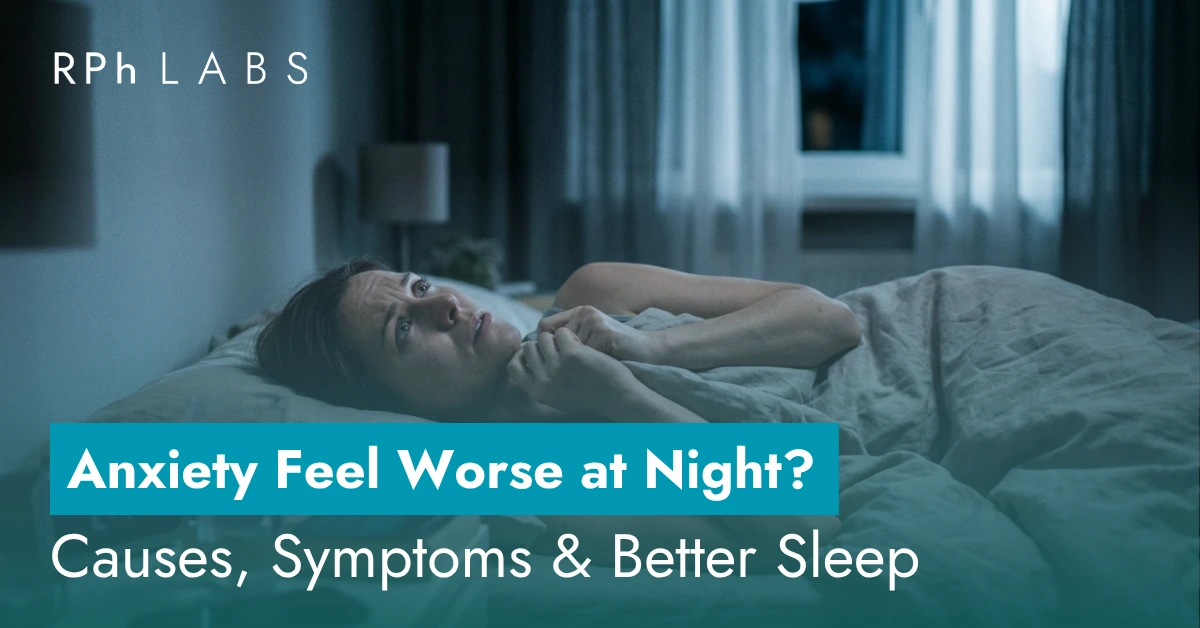
The lights go off, the house goes quiet, and your mind picks that exact moment to start racing. Sleep anxiety, worry, racing thoughts, or a pounding heart that spikes right at bedtime is one of the most common patterns anxious people describe, and it rarely comes out of nowhere. Many people reach bedtime feeling exhausted but still can’t sleep because their mind refuses to slow down. Nighttime anxiety has real physical drivers: a natural dip in stress hormones, fewer distractions competing with your thoughts, and a nervous system that hasn’t had a chance to downshift.
This guide covers why anxiety feels worse at night, how to tell it apart from a nocturnal panic attack or a sleep disorder, and why the same anxiety medication can calm one person’s symptoms while barely touching someone else’s.
Why Is My Anxiety Worse at Night?
Anxiety at night often spikes because stress hormones naturally shift after dark, and the daytime noise that usually drowns out worry disappears. Once distractions fall away, your brain finally has room to process what it pushed aside all day. For many people, this shows up as racing thoughts, restlessness, or a wired, on-edge feeling right at bedtime.
- Cortisol dip: Cortisol, your main stress hormone, typically drops in the evening for some anxious people; that drop lines up with a sudden awareness of worry instead of calm.
- Fewer distractions: Work, errands, and conversation fill the day; at night, an anxious brain has nothing left to compete with.
- Nighttime rumination: Your brain’s “default mode network,” the part that runs when you’re not focused on a task, becomes more active at rest and starts replaying unresolved worries.
- Screen time: Scrolling right before bed keeps your nervous system alert instead of winding down.
What Does Sleep Anxiety Actually Feel Like?
Sleep anxiety symptoms usually mix mental and physical signs: a racing heart, a tight chest, an unsettled stomach, and thoughts that loop without resolving. Some people notice nighttime nausea or a heavy, dreadful feeling with no clear trigger. These symptoms can hit right at bedtime, or wake someone up hours later.
- Racing or looping thoughts that resist “just relaxing”.
- A pounding or fluttering heartbeat.
- Nausea or stomach unease, often tied to the gut-brain connection under stress.
- Restlessness, sweating, or feeling too warm or cold.
- Waking suddenly around 2 to 4 a.m. with a jolt of worry.
Can Anxiety Cause a Panic Attack While You’re Asleep?
Yes, nocturnal panic attacks are real and documented, not just an intense nightmare. They wake a sleeping person abruptly with a pounding heart, shortness of breath, sweating, and a sudden feeling of impending doom, usually peaking within about ten minutes. Unlike a nightmare, there’s no dream attached to it; the panic itself is what wakes the person.
| What you notice | Most likely explanation |
| Racing thoughts, worry loops, steady heart rate | Sleep anxiety or rumination |
| Sudden waking, pounding heart, choking feeling, fast peak | Nocturnal panic attack |
| Loud snoring, gasping, morning headache, daytime exhaustion | Possible sleep apnea, worth a conversation with a doctor |
Sleep apnea and anxiety overlap more than people expect. Repeated awakenings from blocked breathing send a surge of adrenaline and cortisol through your body, producing the same racing heart and dread as a panic attack, so an accurate diagnosis matters before anxiety alone gets the blame.
Is Being Afraid to Fall Asleep a Real Condition?
Yes, an intense, ongoing fear of sleep, sometimes called somniphobia or somnophobia, shows up more in people who’ve had frightening nightmares, sleep paralysis, or a scary nighttime experience in the past. It goes beyond typical bedtime anxiety because the fear centers on sleep itself, not just what might happen afterward.
- Often tied to nightmare disorder, sleep paralysis, PTSD, or panic disorder.
- Can look like stalling at bedtime, checking locks repeatedly, or needing a light on.
- Different from general nighttime anxiety because the trigger is losing control, not just racing thoughts.
- Usually responds to the same approaches used for other anxiety disorders: talk therapy, gradual exposure, and addressing the root cause.
Does Melatonin Work for Nighttime Anxiety?
Melatonin sets your body’s internal clock; it isn’t an anti-anxiety medication. It can shorten the time it takes to fall asleep without necessarily calming a racing mind, and for some people it does the opposite: more vivid dreams, morning grogginess, or extra jitteriness the next day.
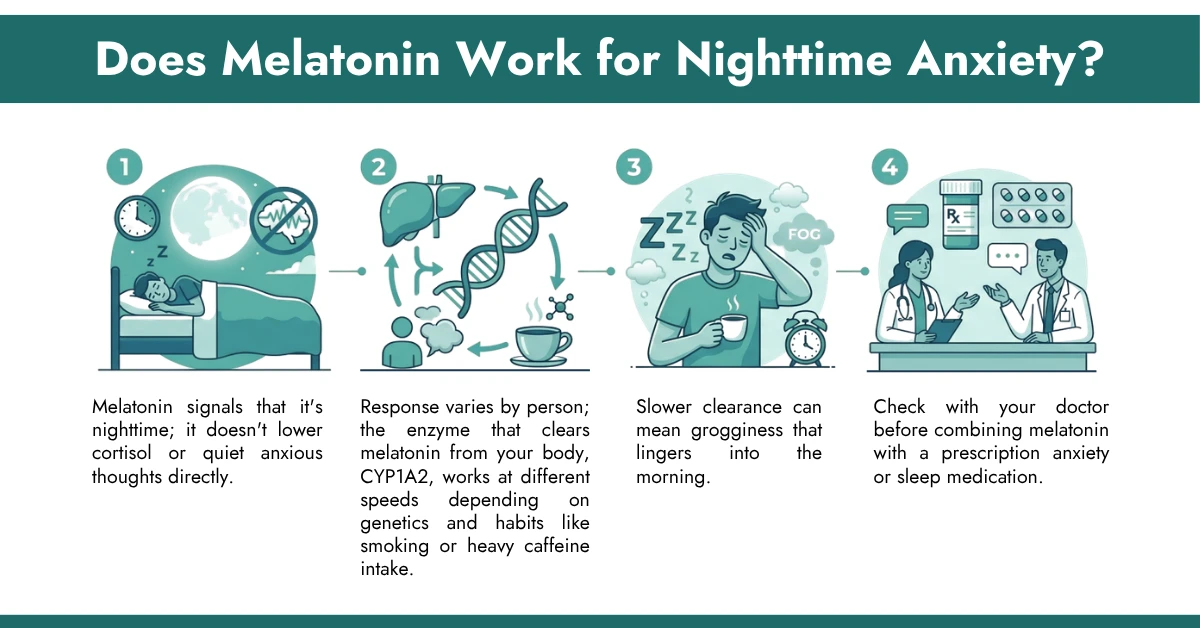
- Melatonin signals that it’s nighttime; it doesn’t lower cortisol or quiet anxious thoughts directly.
- Response varies by person; the enzyme that clears melatonin from your body, CYP1A2, works at different speeds depending on genetics and habits like smoking or heavy caffeine intake.
- Slower clearance can mean grogginess that lingers into the morning.
- Check with your doctor before combining melatonin with a prescription anxiety or sleep medication.
Many commonly prescribed medications, including SSRIs like sertraline, citalopram, escitalopram, fluoxetine, and paroxetine, are metabolized differently from one person to another.
What Actually Calms Nighttime Anxiety?
Real relief comes from lowering physical arousal before bed, not from trying to think your way out of worry. A predictable bedtime routine, a screen-free wind-down window, and a way to offload racing thoughts onto paper all signal safety to your nervous system.
- Write down tomorrow’s to-do list and lingering worries earlier in the evening, not once you’re in bed.
- Keep a steady sleep and wake time, weekends included.
- Cut caffeine after early afternoon; it can trigger anxiety symptoms hours later as your body clears it.
- Try slow breathing with a longer exhale than inhale; this cues your nervous system to settle.
- Save your bed for sleep only, so your brain stops linking it to scrolling or worrying.
Why Do Anxiety Medications Work Differently for Different People?
Two people can take the same anxiety or sleep medication and land in completely different places: one feels calmer within days, another feels nothing or gets hit with side effects. A real piece of that difference comes down to genetics, specifically how fast your liver enzymes break the medication down.
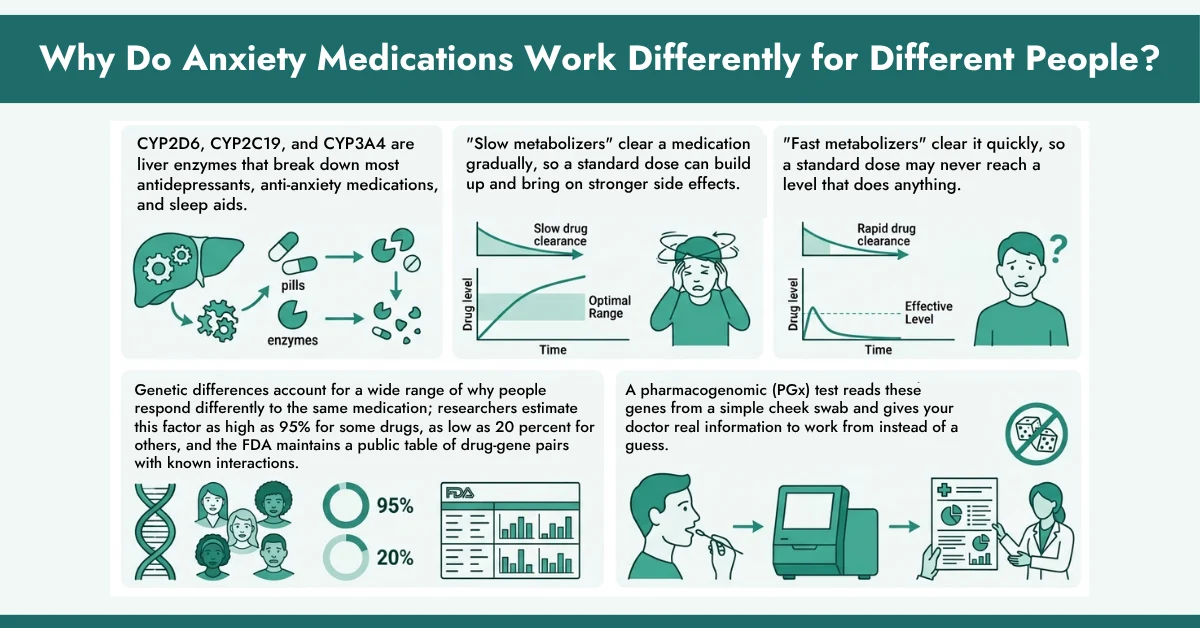
- CYP2D6, CYP2C19, and CYP3A4 are liver enzymes that break down most antidepressants, anti-anxiety medications, and sleep aids.
- “Slow metabolizers” clear a medication gradually, so a standard dose can build up and bring on stronger side effects.
- “Fast metabolizers” clear it quickly, so a standard dose may never reach a level that does anything.
- Genetic differences account for a wide range of why people respond differently to the same medication; researchers estimate this factor as high as 95% for some drugs, as low as 20 percent for others, and the FDA maintains a public table of drug-gene pairs with known interactions.
- A pharmacogenomic (PGx) test reads these genes from a simple cheek swab and gives your doctor real information to work from instead of a guess.
RPh Labs’ at-home PGx testing kit checks how your body is likely to process 240+ medications, including several used for anxiety and sleep, with results sent to a secure account in 7-10 business days. A PGx test doesn’t replace a doctor’s judgment; it’s one more piece of information a doctor can weigh alongside your history and symptoms, not a stand-alone diagnosis.
Conclusion:
Nighttime anxiety has real, explainable causes: hormones, an overactive nervous system, and sometimes genetics are usually behind it. None of that makes it something to push through alone, especially when it happens most nights. If trial-and-error with anxiety or sleep medication has left you frustrated, a PGx test can give your doctor a clearer starting point instead of a guess.
Frequently Asked Questions
Yes. Missing sleep affects the parts of the brain that regulate emotions, making everyday stress feel more intense. Poor sleep raises anxiety levels, and anxiety makes it harder to sleep, creating a cycle that can repeat night after night.
It can. Caffeine has a half-life of about five to six hours, meaning a mid-afternoon coffee may still be active at bedtime. For people who are sensitive to caffeine, this can raise heart rate, increase alertness, and make it harder to fall asleep.
Not always. Stressful life events can cause temporary anxiety at bedtime. If nighttime anxiety becomes frequent, disrupts sleep for weeks, or affects daily life, it’s worth discussing with a doctor since it may indicate an anxiety disorder or another sleep-related condition.
Many people wake up anxious because cortisol, the body’s natural wake-up hormone, rises before morning. Poor sleep, chronic stress, anxiety disorders, or conditions like sleep apnea can make this normal hormonal change feel much stronger, leading to a racing heart or overwhelming worry upon waking.
Yes. Anxiety is one of the most common causes of insomnia. Racing thoughts, muscle tension, and an activated fight-or-flight response can make it difficult to fall asleep, stay asleep, or return to sleep after waking during the night.
No. Medicare does not cover PGx testing as a general screening or preventive measure. Coverage requires medical necessity tied to a specific drug under current consideration.
Yes. Children can experience sleep anxiety, particularly during periods of stress, major life changes, or after frightening experiences. Persistent bedtime fears, repeated nightmares, or ongoing refusal to sleep alone should be discussed with a pediatrician or mental health professional.
Older adults may experience more nighttime anxiety due to changes in sleep patterns, chronic medical conditions, medications, loneliness, or cognitive changes. A medical evaluation can help identify whether anxiety, a sleep disorder, or another health condition is contributing to nighttime symptoms.
Leave the bed if you haven’t fallen asleep after about 20 minutes. Read a book, practice slow breathing, or try another quiet, relaxing activity under dim light until you feel sleepy. If insomnia or nighttime anxiety continues for several weeks, talk with your doctor to identify the underlying cause and discuss appropriate treatment options.
Leave a Reply