




A headache builds behind one eye two days before your period, right on schedule. No amount of coffee or Tylenol touches it. If this happens most months, you’re dealing with a menstrual migraine. Doctors also call it a hormonal migraine, tied to the drop in estrogen right before your period starts. Roughly half of women with migraine notice this pattern. Standard headache advice rarely accounts for the hormone piece. The same migraine medication that works well for a friend can do very little for you. Part of that comes down to how your body clears it. Here’s what causes menstrual migraines, how to spot the pattern, what actually eases them, and where genetics fits in.
What Is a Menstrual Migraine?
A menstrual migraine, also called a catamenial migraine, clusters around your period. It typically runs from two days before bleeding starts through day three of your period, a five-day window. Doctors split this into two patterns.
- Pure menstrual migraine: Attacks show up only around your period, never at other points in the cycle. This is the rarer pattern.
- Menstrually related migraine: Attacks show up around your period and at other times too. Most women with a cycle-linked pattern fall here.
Both patterns share the same core trigger. A sharp fall in estrogen right before your period sets the attack in motion.
Why Do Hormones Trigger Migraines Before Your Period?
Estrogen climbs through the month, then drops sharply in the two days before your period. That drop, not a flat low level, sets off the migraine for most women. Progesterone falls around the same time, though research points to the estrogen dip as the stronger trigger. Prostaglandins, hormone-like compounds released during your period, add to the pain. They’re a likely reason cramps often show up alongside the headache.
| Cycle Phase | Estrogen | Migraine Risk |
| Period (Days 1-5) | Low | High, especially days 1-2 |
| Follicular (Days 6-13) | Climbing | Low |
| Ovulation (~Day 14) | Peaks, then dips | Some women feel a mid-cycle headache |
| Luteal (Days 15-25) | Elevated | Low |
| Late luteal (Days 26-28) | Drops sharply | Highest, the classic trigger window |
This same estrogen-withdrawal pattern explains another common complaint: A headache during the placebo week on hormonal birth control, not just around a natural period.
What Does a Menstrual Migraine Feel Like?
A menstrual migraine usually brings throbbing, one-sided head pain. Nausea and sharp sensitivity to light and sound are common too. Those are the usual signs of migraine at any time of the month, just often worse here. Compared with migraines elsewhere in your cycle, the perimenstrual kind tends to run longer and hit harder. It also tends to skip the visual aura, even in women who get aura on other days.
Common symptoms include:
- Throbbing pain, usually on one side of the head.
- Nausea, sometimes with vomiting.
- Sensitivity to light and sound.
- Neck stiffness.
- Feeling lightheaded or foggy.
- Extra-heavy cramps on the same days.
Can Ovulation Cause Migraines or Headaches?
Yes. A second, usually milder headache can show up around ovulation, roughly two weeks before your period. This happens when estrogen peaks and then briefly dips. Some women feel this ovulation migraine as a dull ache. Others barely notice it. Luteal phase headaches in the days after ovulation are a separate but related pattern, tied to the progesterone rise and fall later in the cycle. Tracking headaches against your cycle for two to three months is the clearest way to tell these apart from your main premenstrual attack.
How Do You Stop a Menstrual Migraine Before It Starts?
Timing sets menstrual migraine prevention apart from typical migraine care. The trigger window is predictable. Many women start a medication a few days ahead of it, rather than waiting for the pain to begin. Headache specialists call this mini-prevention.
Options doctors commonly discuss:
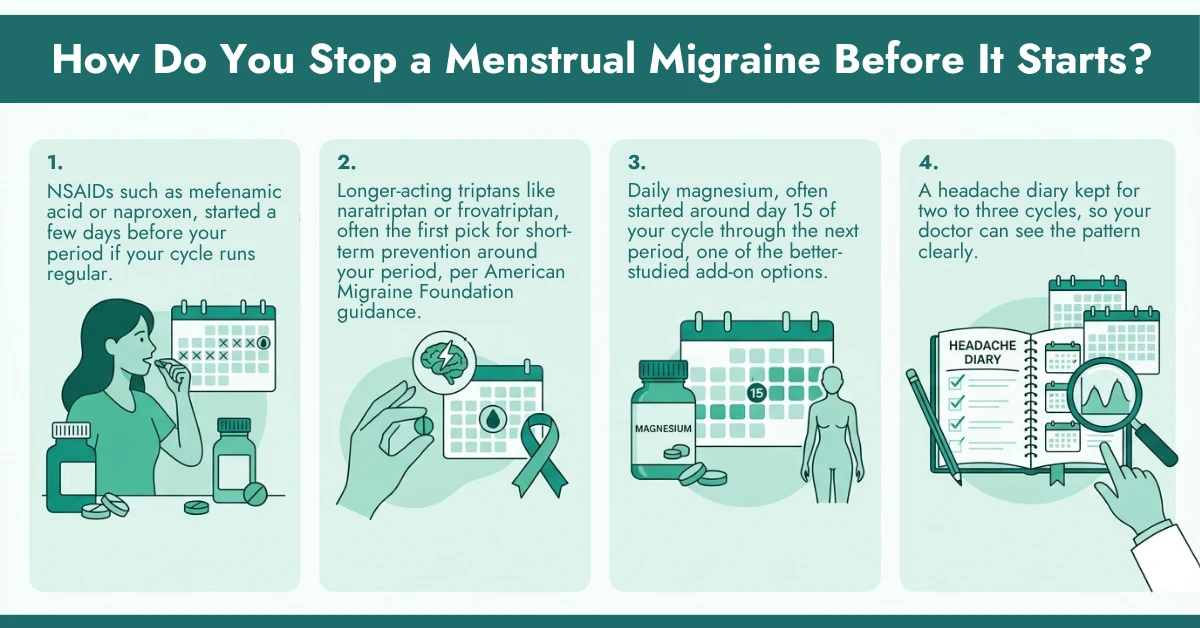
- NSAIDs such as mefenamic acid or naproxen, started a few days before your period if your cycle runs regular.
- Longer-acting triptans like naratriptan or frovatriptan, often the first pick for short-term prevention around your period, per American Migraine Foundation guidance.
- Daily magnesium, often started around day 15 of your cycle through the next period, one of the better-studied add-on options.
- A headache diary kept for two to three cycles, so your doctor can see the pattern clearly.
Ask your doctor which combination fits your cycle and health history.
Can Birth Control Help Prevent Menstrual Migraines?
Some hormonal birth control smooths out the estrogen drop that triggers these migraines by keeping levels steadier across the month. Others don’t fit every migraine pattern. Your migraine history is what decides which is safe.
If you get migraine with aura, visual sparkles, zigzag lines, or numbness before the headache, combined estrogen-containing birth control is generally off the table. ACOG lists it as a contraindication, tied to a higher stroke risk in that group. Progestin-only pills, an implant, a hormonal IUD, or an injection like Depo-Provera are the usual safer routes instead.
If you don’t get aura, continuous or extended-cycle combined birth control is one option. Skipping the placebo week can prevent the estrogen dip altogether. Women approaching perimenopause sometimes add a low-dose estrogen patch for the same reason. Bring your full migraine history, aura included, to this talk with your OB-GYN or neurologist.
Can Genetics Affect How Migraine Medications Work?
Sometimes the plan is right and the medication is still the problem. Liver enzymes control how fast you clear a drug, and those enzymes are set by your genes. That’s why the same migraine or mood medication can work well for one person and barely touch another.
Pharmacogenomic (PGx) testing looks at genes like CYP2D6 and CYP2C19. The FDA’s drug-labeling database links these genes to more than a hundred approved medications. Both shape how your body breaks down amitriptyline and propranolol, two drugs sometimes prescribed off-label to prevent migraine. The same genes affect SSRIs like citalopram and fluoxetine, sometimes prescribed for PMDD symptoms on the same days as your headache.
RPh Labs’ at-home PGx testing kit checks how your body is likely to handle 240+ medications from one cheek swab, sent to a CLIA-accredited lab, with results in 7-10 business days. The kit is $299, HSA/FSA eligible, and splits into four no-interest payments. See how it works or the full gene and drug list.
Conclusion:
Menstrual migraines follow a pattern once you track them against your cycle. That patStern is what makes them treatable: timed medication, the right birth control choice for your aura history, and knowing how your own body clears what you’re prescribed.
If migraine medications have let you down more than once, an RPh Labs PGx testing kit shows how your genes handle 240+ common drugs, information you can bring straight into your next appointment. Check your state coverage (RPh Labs currently reaches 45 states) and order your kit online.
Disclaimer:
This article is educational. It’s not a stand-in for advice from your own doctor, neurologist, or genetic counselor. Talk with them before you start, stop, or switch any medication or birth control.
Frequently Asked Questions
A falling estrogen level, not a flat low level on its own, is the bigger trigger. The two-to-three-day drop before your period is when most menstrual migraines start. Timing matters more than the number on any given day.
Endometriosis has a well-documented, two-way link with migraine; each raises the odds of the other. The PCOS-migraine connection is far less settled; research so far hasn’t found a consistent link. Mention both conditions to your doctor if you have them.
Yes. Nausea, lightheadedness, and extra light sensitivity are common with menstrual migraines. On their own, they don’t point to a separate problem. Symptoms that are severe, new, or don’t ease up are still worth a call to your doctor.
These attacks often run longer than migraines at other points in the month, sometimes a full day or more. They can also respond less to the first dose of medication. That’s part of why timed prevention matters for this pattern.
See a doctor if migraines show up most months, disrupt work or school, or don’t ease with over-the-counter pain relief. A neurologist or OB-GYN can map the pattern against your cycle and adjust your plan.
Leave a Reply