




You’ve tried three different migraine medications, and none worked the way your neurologist promised. Your sister takes the same triptan and gets relief within an hour. That gap between two people with the same diagnosis often traces back to DNA. Migraine itself runs in families, and the genes you inherit also change how your body processes the medications meant to treat it.
Below is what current research shows about migraine genetics and migraine treatment, from family risk to the specific genes tied to triptans, preventive drugs, and gepants.
Is Migraine Hereditary?
Yes. Twin and family studies put migraine’s heritability at roughly 35%-60%, and the American Migraine Foundation notes that a person with one migraine-affected parent has a 50%-75% chance of developing migraine too. That makes migraine one of the more strongly inherited neurological conditions, even without a single gene behind it.
- First-degree relatives of someone with migraine face 1.4-3 times the typical risk.
- Migraine affects an estimated 39 million people in the U.S., roughly 12%-15% of adults, and closer to 1 in 5 women.
- Genetics set the risk level; hormones, sleep, stress, and other triggers decide when an attack actually happens.
What Genes Are Linked to Migraine Risk?
No single “migraine gene” exists. Genome-wide studies have tied migraine risk to dozens of DNA regions, most involved in nerve signaling or blood vessel regulation, including TRESK and MTHFR.
A narrow exception is familial hemiplegic migraine (FHM), a rare, distinct subtype passed down in an autosomal dominant pattern, meaning one altered gene copy from a single parent is enough to cause it. FHM traces to mutations in three specific genes:
- CACNA1A (FHM type 1).
- ATP1A2 (FHM type 2).
- SCN1A (FHM type 3).
Researchers note these three genes explain FHM specifically. They play little to no role in the common migraine most people live with.
Why Do Migraine Medications Work Differently for Different People?
Two people with an identical migraine diagnosis can fill the same prescription and land on opposite outcomes. Genes that control liver enzymes are a major reason.
Those enzymes decide how fast a drug clears your system.
- A “poor metabolizer” breaks a drug down slowly, so it can build up and cause side effects at a standard dose.
- A “rapid” or “ultrarapid” metabolizer clears the same drug so fast it may never reach a working level. Neither pattern shows up on a routine blood panel; it’s written into DNA, which is where pharmacogenomic testing comes in.
Which Genes Affect How Migraine Medications Are Broken Down?
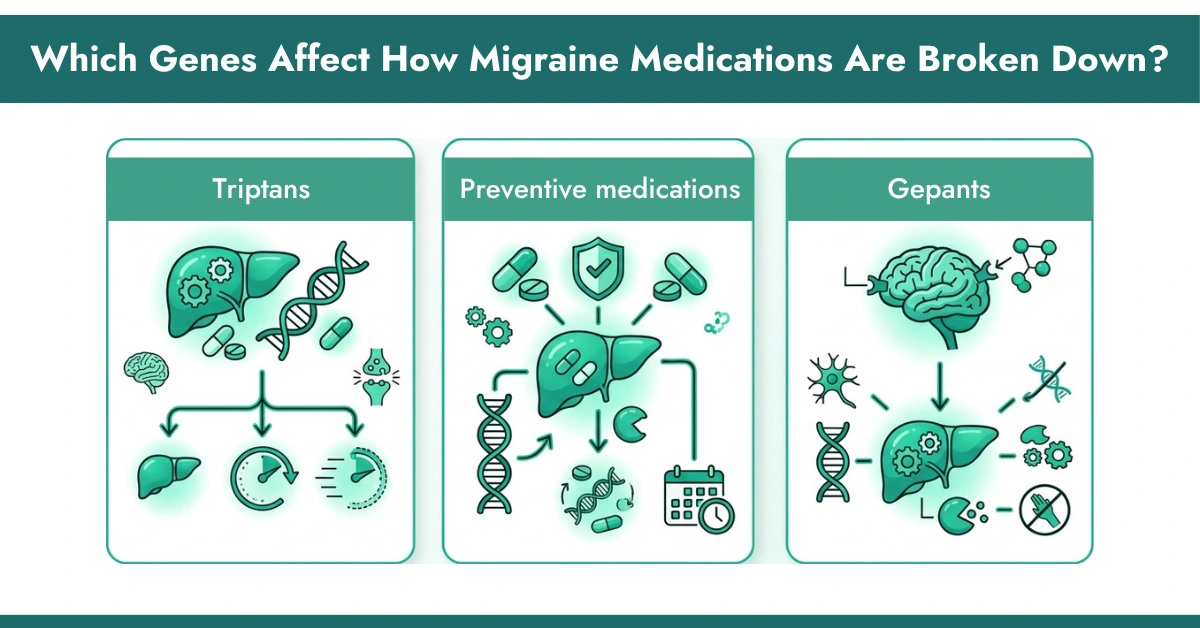
Several liver enzymes govern how the body clears migraine drugs, and the specific enzyme depends on the drug class:
- Triptans: Sumatriptan and rizatriptan rely mainly on the MAO-A enzyme; zolmitriptan runs through CYP1A2 and MAO-A; almotriptan uses CYP3A4 and MAO-A; eletriptan, frovatriptan, and naratriptan lean on the broader CYP450 pathway. That split is a documented reason one triptan works well while another does nothing for the same person.
- Preventive medications: Amitriptyline, prescribed off-label for migraine prevention, is processed through CYP2D6 and CYP2C19. The Clinical Pharmacogenetics Implementation Consortium (CPIC) already publishes dosing guidance for people whose genes make them poor or ultrarapid metabolizers of this drug class, and the FDA’s Table of Pharmacogenomic Biomarkers in Drug Labeling lists dozens of comparable drug-gene pairs.
- Gepants: Newer options like rimegepant and atogepant are metabolized mainly through CYP3A4, the same enzyme affected by genetics and by certain other medications a person might already take.
Does the MTHFR Gene Cause Migraines?
Not on its own. MTHFR affects how the body handles folate and homocysteine, and several studies connect one MTHFR variant (C677T) to a higher rate of migraine with aura. Other studies find no connection; researchers describe the evidence as inconsistent rather than settled.
No medical guideline currently recommends MTHFR testing as a stand-alone way to diagnose or predict migraine. It’s one data point in a larger genetic picture, not a verdict by itself.
Can a DNA Test Help Find the Right Migraine Medication?
A pharmacogenomic (PGx) test reads how your specific genes process medications, giving your doctor a data point on which drug classes and doses fit your metabolism before you cycle through options by trial and error.
RPh Labs’ at-home PGx test is CLIA-accredited and COLA-accredited, and checks how your body may respond to 240+ medications from a single cheek swab:
- Order the PGx testing kit online.
- Swab your cheek and mail the sample back in the prepaid envelope; full steps are on the how it works page.
- Get results in 7-10 business days through the online Genie portal.
- Check the gene-drug list for the specific medications your report covers.
A PGx report is one input your prescriber weighs alongside your symptoms and history, not a stand-alone diagnosis or a guarantee any one drug will work.
What Should You Do If Migraine Runs in Your Family?
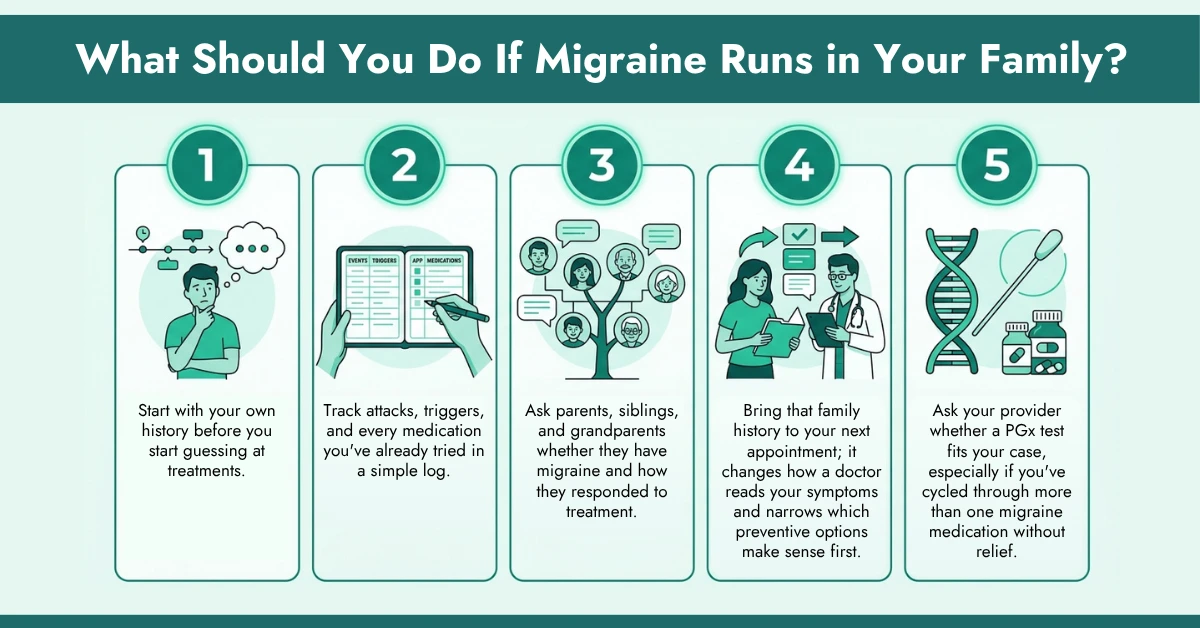
- Start with your own history before you start guessing at treatments.
- Track attacks, triggers, and every medication you’ve already tried in a simple log.
- Ask parents, siblings, and grandparents whether they have migraine and how they responded to treatment.
- Bring that family history to your next appointment; it changes how a doctor reads your symptoms and narrows which preventive options make sense first.
- Ask your provider whether a PGx test fits your case, especially if you’ve cycled through more than one migraine medication without relief.
Conclusion:
Migraine genetics decide more than whether the condition runs in your family; they shape how your body responds to the medications meant to treat it. If you’ve cycled through migraine treatments without relief, that pattern may trace back to biology rather than bad luck.
See which migraine medications match your biology. Check if your medication is on our list or order your PGx testing kit.
Disclaimer:
This article is educational and isn’t a substitute for individualized medical or genetic counseling. Talk with your doctor or a genetic counselor before making treatment decisions based on genetic test results.
Frequently Asked Questions
No. Migraine is a distinct neurological condition with a documented genetic component. Tension headaches and other headache types don’t carry the same inherited pattern researchers have mapped for migraine.
Yes. Migraine comes from a mix of many small genetic effects plus environmental triggers, so a first case in a family is possible; heritability studies describe a strong pattern, not a guarantee.
Familial hemiplegic migraine is a rare, specific subtype tied to three known genes (CACNA1A, ATP1A2, SCN1A). Researchers note these genes explain FHM but play little to no role in the common migraine most people experience.
The test screens 240+ medications across categories including pain and psychiatric drug classes, several of which overlap with migraine prevention. Check the gene-drug list for your specific prescriptions before ordering.
Coverage varies by plan. The $299 RPh Labs test is HSA/FSA-eligible and ships with an interest-free 4-installment payment option for anyone paying out of pocket. Check your insurance details before ordering.
Leave a Reply