




Sore legs & heavy shoulders. Aching that started right around the time you filled a new cholesterol prescription. If this sounds familiar, you’re dealing with one of the most common complaints tied to statins: muscle pain.
Doctors call it statin-induced myopathy once it’s confirmed by bloodwork, and myalgia when it’s soreness alone. Either way, it’s a leading reason people ask their prescriber for a change. Some people never feel a thing on a given statin. Others notice it within a week. Dose, other medications, and genetics all play a part in that difference.
Here’s what’s behind the ache: why statins cause muscle pain, which ones carry more of that risk, the warning signs worth same-day attention, and where genetic testing fits in.
What Happens When a Statin Causes Muscle Pain?
Muscle pain from statins isn’t one condition; it’s a range. Myalgia means soreness with normal bloodwork. Myopathy means that same soreness plus a real rise in creatine kinase (CK), a protein muscle cells release under stress. Rhabdomyolysis sits at the far end: muscle tissue breaks down fast enough to threaten the kidneys.
Clinical trials put the rate of muscle symptoms around 1% to 5% of statin users. Real-world reporting, outside a trial’s tighter screening, runs closer to 10%, sometimes higher. Same drug class, different counting method, and a reminder that trial numbers and lived experience don’t always match.
Why Do Statins Cause Muscle Pain?
Statins block an enzyme called HMG-CoA reductase, which your liver uses to make cholesterol. That same pathway also makes CoQ10, a compound muscle cells burn for energy. Less CoQ10 may mean less fuel for muscle, one leading theory behind the ache.
Genes play a role too. A well-documented variant in the SLCO1B1 gene changes how much simvastatin builds up in muscle rather than clearing through the liver. In a large genome-wide study of high-dose (80mg) simvastatin users, carriers of this variant showed roughly four times the myopathy risk of non-carriers, according to genetics research published through the National Institutes of Health. That finding is part of why regulators later restricted new prescriptions of the 80mg simvastatin dose. RPh Labs’ PGx panel checks CYP2C9, a separate liver enzyme tied to statin metabolism.
Are Some Statins More Likely to Cause Muscle Pain?
Some, yes, though the old rule of thumb is less tidy than it sounds. Lipophilic (fat-soluble) statins atorvastatin, simvastatin, lovastatin, fluvastatin slip into muscle tissue more easily. Hydrophilic (water-soluble) statins, pravastatin, rosuvastatin, stay closer to the liver.
| Statin (Generic) | Brand Name | Solubility Type | Typical Intensity Range |
| Atorvastatin | Lipitor | Lipophilic | Moderate to high |
| Rosuvastatin | Crestor | Hydrophilic | Moderate to high |
| Simvastatin | Zocor | Lipophilic | Low to moderate |
| Pravastatin | Pravachol | Hydrophilic | Low to moderate |
| Lovastatin | Mevacor | Lipophilic | Low to moderate |
| Fluvastatin | Lescol | Lipophilic | Low to moderate |
Exact intensity depends on the prescribed dose, not the drug alone.
Real-world data has muddied that clean split. A large UK health-record cohort study found muscle-event rates were close between hydrophilic and lipophilic statins at matched doses, hydrophilic rosuvastatin even edged slightly above lipophilic atorvastatin, though the gap was too small to rule out chance. Dose and individual biology drive the outcome at least as much as chemistry does.
Who Has a Higher Risk of Muscle Pain From Statins?
Some factors make muscle pain with statin drugs more likely.
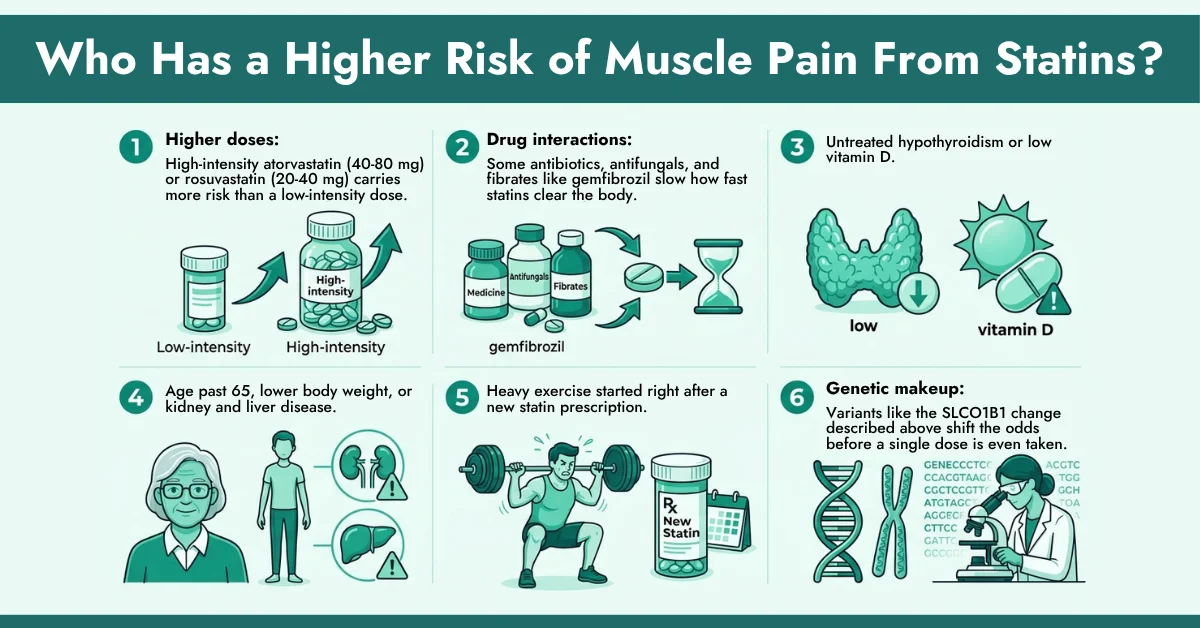
Risk factors include:
- Higher doses: High-intensity atorvastatin (40-80 mg) or rosuvastatin (20-40 mg) carries more risk than a low-intensity dose.
- Drug interactions: Some antibiotics, antifungals, and fibrates like gemfibrozil slow how fast statins clear the body.
- Untreated hypothyroidism or low vitamin D.
- Age past 65, lower body weight, or kidney and liver disease.
- Heavy exercise started right after a new statin prescription.
- Genetic makeup: Variants like the SLCO1B1 change described above shift the odds before a single dose is even taken.
When Is Statin Muscle Pain an Emergency?
Most statin-related muscle pain is mild and settles on its own or with a dose change. A small share of cases point toward rhabdomyolysis, which calls for same-day care.
Contact a doctor immediately, or head to an emergency room, for:
- Dark, tea-colored, or cola-colored urine.
- Serious muscle weakness or swelling.
- Muscle pain paired with fever, confusion, or very little urine output.
A CK blood test confirms it; waiting it out isn’t the move here.
Can Genetic Testing Explain Why Statin Causes Muscle Pain?
Genetics is one reason two people on the identical dose of the identical drug feel completely different things. RPh Labs’ at-home PGx testing kit looks at CYP2C9 and dozens of other genes against 240+ medications, statins among them. A cheek swab, mailed back in a prepaid envelope, gets you a result through a secure portal in 7-10 business days, with a clinical pharmacist or genetic counselor to walk through what it means.
A PGx report doesn’t diagnose muscle pain on its own, and it’s not a swap-in for a CK test or a doctor’s exam. What it gives your prescriber is one more data point when choosing a statin, or a dose, matched to how your body handles it. See the full list of genes and medications the panel covers, or check how testing works before ordering.
What Can You Do About Statin-Related Muscle Pain?
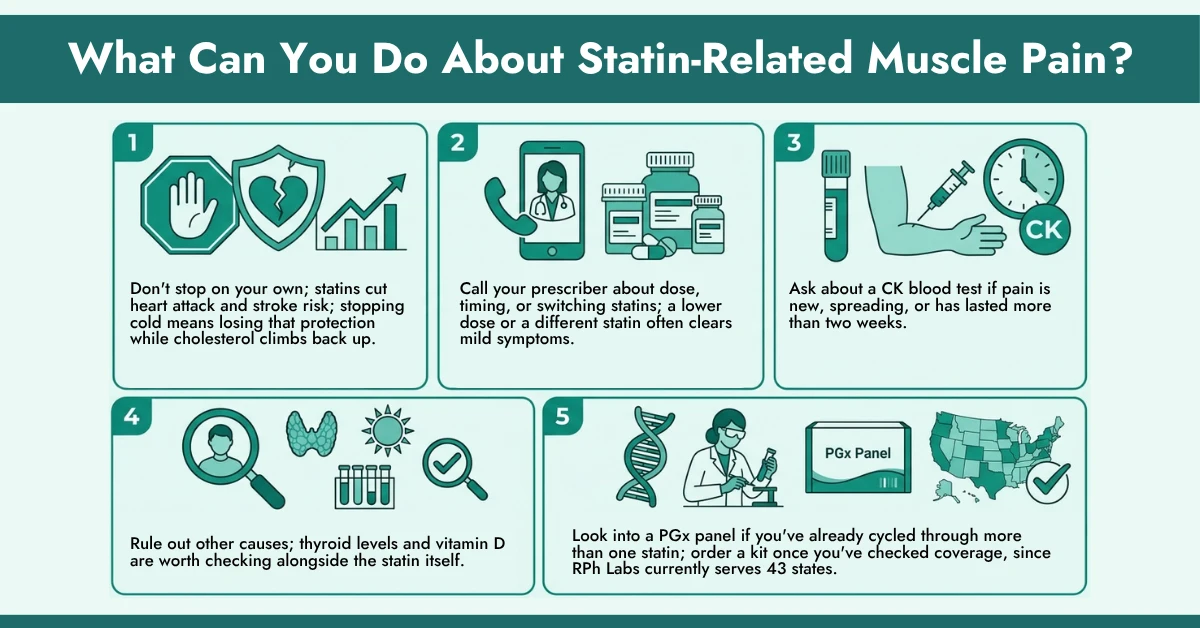
- Don’t stop on your own; statins cut heart attack and stroke risk; stopping cold means losing that protection while cholesterol climbs back up.
- Call your prescriber about dose, timing, or switching statins; a lower dose or a different statin often clears mild symptoms.
- Ask about a CK blood test if pain is new, spreading, or has lasted more than two weeks.
- Rule out other causes; thyroid levels and vitamin D are worth checking alongside the statin itself.
- Look into a PGx panel if you’ve already cycled through more than one statin; order a kit once you’ve checked coverage, since RPh Labs currently serves 43 states.
Conclusion:
Muscle pain on a statin is common enough to take seriously and, in most cases, mild enough not to panic over. Genetics is one piece of a larger picture that also includes dose, drug interactions, and thyroid or vitamin D levels.
RPh Labs’ at-home PGx testing kit gives your prescriber genetic information to work with: a cheek swab, a mailed lab, and results back in 7-10 business days, with a clinical pharmacist reviewing them alongside you. Check whether RPh Labs currently serves your state before you order.
Frequently Asked Questions
No. Atorvastatin and other statins lower cholesterol by blocking a liver enzyme. Blood thinners, warfarin, DOACs, and aspirin work on clotting through a completely different mechanism.
Not without calling your prescriber first. Stopping suddenly removes the cardiovascular protection statins give you. Muscle pain often clears up with a dose change or a different statin instead.
Short-acting statins like simvastatin and pravastatin clear the body within hours, and the liver makes the most cholesterol overnight; a bedtime dose lines up with that cycle. Atorvastatin and rosuvastatin last much longer, so timing matters less for those two.
Clinical trials show roughly 1% to 5%. Real-world reporting, which catches people trial screening would have excluded, runs closer to 10%, sometimes higher.
It can flag gene variants tied to how your body handles certain statins, one more data point for your prescriber alongside dose and labs. It’s not a guarantee, and it doesn’t replace a CK test or a medical exam.
Leave a Reply