



You’ve tried an antidepressant that didn’t work. Or a pain medication that barely touched the pain, or worse, caused a reaction nobody expected. That trial-and-error cycle has a name: pharmacogenomics (often shortened to PGx), the study of how your genes shape your response to a drug.
For a growing list of medications, doctors don’t just guess anymore they check first. A PGx test reads specific genes tied to how your body absorbs, breaks down, and reacts to medication, and for some drugs, that check now comes before the prescription, not after a bad reaction. Here’s which medications typically call for testing first, what the test actually looks at, and how to get one done from home.
What Is a PGx Test & When Is It Needed?
A PGx test (also called a pharmacogenetic test) looks at genes that control how your liver breaks down medication and how your body’s receptors respond to it. The result tells you and your doctor whether a standard dose is likely to work, needs adjusting, or should be swapped for a different drug entirely. Not every medication needs this check the FDA splits drugs into three groups on this exact question:
- Required or necessary: The prescribing information indicates that genetic or genomic information is needed for safe or appropriate use in a specified circumstance.
- Recommended or considered: The labeling or clinical guidance supports considering genetic testing for particular patients or treatment decisions.
- Informational: The label contains pharmacogenomic information about drug response, exposure, or risk, but does not establish a requirement to test every patient.
Knowing which bucket your medication falls into is the real question behind “does this drug need genetic testing” a blanket yes-or-no answer rarely fits.
Which Medications Have Important Gene-Drug Interactions?
Genetic testing shows up most often around four types of medication: psychiatric drugs, blood thinners, cancer or immune-suppressing drugs, and certain pain and hormone therapies. Here’s where it applies most, based on FDA labeling and current research:
- Psychiatric medications: Citalopram, fluoxetine, and paroxetine are metabolized differently depending on your CYP2D6 and CYP2C19 status, which affects both side effects and how well the dose works.
- Blood thinners: Warfarin and rivaroxaban dosing can swing widely based on CYP2C9 and VKORC1 genes, raising bleeding risk if the starting dose is off.
- Chemotherapy and autoimmune drugs: Azathioprine, methotrexate, and carboplatin carry genetic warnings tied to TPMT and related genes, since a poor metabolizer can face severe toxicity.
- Hormone and pain therapies: Drugs like elagolix, plus several opioids, have documented gene-drug interactions worth checking before the first dose.
RPh Labs’ PGx testing kit screens for all of these medications and 240+ more from a single cheek swab. See the full gene and medication list for specifics.
How Do Genes Affect the Way a Medication Works?
Most of the genes involved in medication response control an enzyme family called CYP450, especially CYP2D6, CYP2C19, CYP2C9, and CYP3A4, which break drugs down in the liver. A variant can make you clear a drug too fast, too slow, or not at all. VKORC1 affects vitamin K, which changes how blood thinners work. TPMT affects how thiopurine drugs like azathioprine get cleared. HLA genes flag a risk of serious allergic-type reactions to specific drugs.
Research published in the New England Journal of Medicine estimates that genetics accounts for roughly 20% to 95% of the difference in how people respond to the same drug, depending on the medication. That wide range is exactly why a genetic test narrows down what your specific genes say, instead of relying on population averages.
Does PGx Testing Use a Blood Sample or Cheek Swab?
Most direct-to-consumer PGx tests, RPh Labs included, use a simple cheek swab, not a blood draw. You collect a saliva sample at home, mail it back in a prepaid envelope, and a CLIA-accredited lab does the rest. Some hospital-based panels use a blood sample instead, especially when testing happens alongside other bloodwork, but for a standalone medication-response test, a swab captures the same DNA information without a needle. If you’ve been searching for a “blood test for genotype,” a cheek swab is the more common, less invasive route most people end up choosing.
What Are the Pros and Cons of PGx Testing?
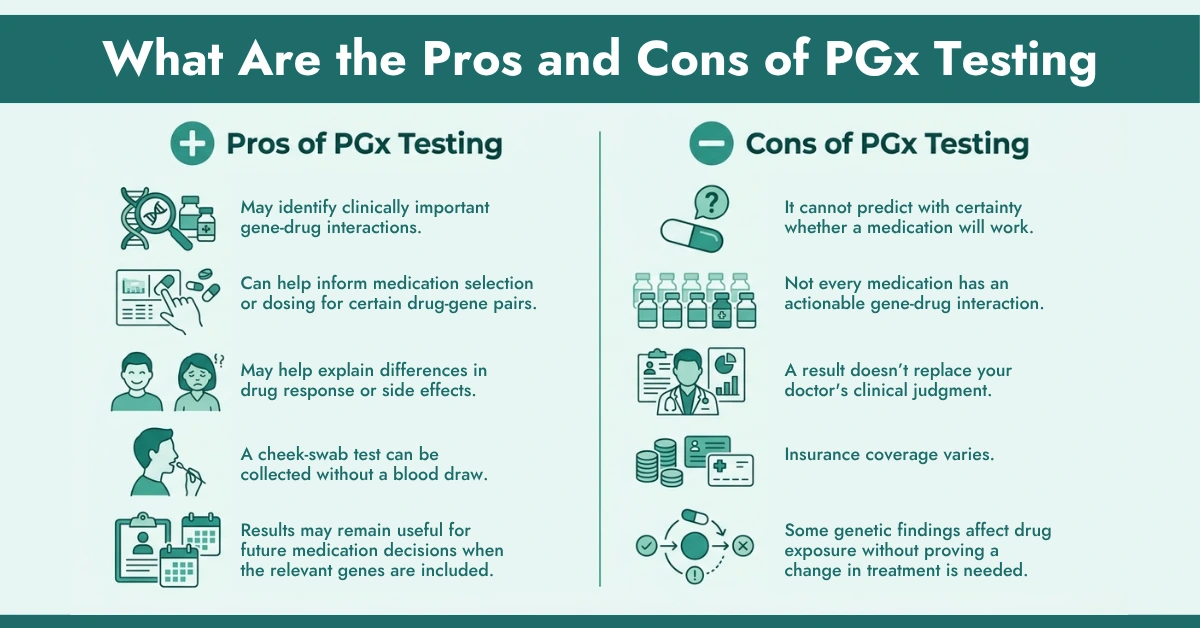
Pros of PGx Testing
- May identify clinically important gene-drug interactions.
- Can help inform medication selection or dosing for certain drug-gene pairs.
- May help explain differences in drug response or side effects.
- A cheek-swab test can be collected without a blood draw.
- Results may remain useful for future medication decisions when the relevant genes are included.
Cons of PGx Testing
- It cannot predict with certainty whether a medication will work.
- Not every medication has an actionable gene-drug interaction.
- A result doesn’t replace your doctor’s clinical judgment.
- Insurance coverage varies.
- Some genetic findings affect drug exposure without proving a change in treatment is needed.
How Does At-Home PGx Testing With RPh Labs Work?
Getting a PGx test through RPh Labs takes four steps, start to finish:
- Order online: The PGx testing kit ships to your door for $299, and it’s HSA/FSA eligible.
- Activate and swab: Register your kit through the online portal and collect the cheek swab.
- Mail it back: Use the prepaid envelope provided with your kit.
- Get your results: A CLIA-accredited, COLA-accredited lab analyzes your sample, and results are posted to your secure account in 7-10 business days, covering 240+ medications.
Full details on each step are on the How It Works page, along with a 4-payment plan at 0% interest for anyone who’d rather split the cost.
Does Insurance Cover Pharmacogenetic Testing?
Coverage for pharmacogenetic testing varies by plan, so the honest answer is: sometimes. RPh Labs currently works with USA Managed Care Organization, Nova Net, Baylor Scott & White Health Plan, Medicare, Texas Medicaid, and Blue Cross Blue Shield of Texas, though prior authorization may apply, and final eligibility comes down to your specific plan. If your insurer isn’t listed, the insurance page walks you through how to confirm coverage before you order, and self-pay is available for anyone whose plan doesn’t cover testing.
Who Should Consider PGx Testing Before Starting a Medication?
Genetic testing makes the most sense before starting a medication with a known gene interaction, or after a medication hasn’t worked the way it should.
That includes:
- Anyone starting an antidepressant or other psychiatric medication for the first time.
- Anyone who’s had a strong side effect from a standard dose of a common drug.
- Caregivers managing ADHD medications, mood stabilizers, or antidepressants for a child or dependent.
- Anyone starting warfarin or another anticoagulant.
RPh Labs currently serves 43 states check the state coverage page to confirm testing is available where you live before you order.
Conclusion:
If a medication hasn’t worked the way you expected, or you’re about to start one with a known gene interaction, a PGx test gives you and your doctor real information instead of a guess. RPh Labs’ at-home kit checks 240+ medications from a single cheek swab, with results in 7-10 days and a 4-payment option if you’d rather split the $299 cost.
Order your PGx testing kit or check your state’s coverage to see if RPh Labs serves your area.
Disclaimer:
This article is educational and isn’t a substitute for medical or genetic counseling advice from a licensed professional. Talk to your doctor or a genetic counselor about what your results mean for your treatment.
Frequently Asked Questions
A PGx test (pharmacogenetic test) analyzes specific genes that affect how your body absorbs, breaks down, and responds to medication. Results show whether a standard dose is likely to work as expected, needs adjusting, or if a different medication might be a better genetic fit.
For the genes it tests like CYP2D6 and CYP2C19. A PGx test accurately identifies your metabolizer status. What it can’t do is guarantee a specific outcome, since mood, other medications, and non-genetic factors also shape how a psychiatric drug works for you.
No. A PGx test is one input your doctor weighs alongside your symptoms, medical history, and other medications, not a replacement for their judgment. It narrows the odds in your favor by ruling out drugs your genes are likely to react poorly to.
Most people get results within 7-10 business days of the lab receiving their sample, delivered through RPh Labs’ secure online portal. You can track your kit’s status the same way.
Not yet. RPh Labs currently serves 45 states New York, Maryland, Pennsylvania, Rhode Island, California, and Florida aren’t covered as of this writing. Check the state coverage page for the current list before you order.
Leave a Reply