



Low desire and pain during sex. Trouble reaching orgasm, no matter how it used to feel. These complaints are common, not rare, and not something to quietly accept. An estimated 4 in 10 women experience some form of sexual difficulty at some point in their lives. Most wait years before mentioning it to a doctor.
Female sexual dysfunction (FSD) is a recognized medical condition, not a personal failing. Some cases trace back to hormones. Others link to a medication a woman is already taking, especially antidepressants. This guide breaks down what FSD actually is, why it happens, and where genetics fits into treatment decisions.
What Is Female Sexual Dysfunction?
Female sexual dysfunction is a group of conditions that disrupt desire, arousal, orgasm, or comfort during sex and cause real distress. The DSM-5 classifies it as a legitimate medical diagnosis, not a mood or a phase.
A woman doesn’t need every symptom on a checklist to qualify. She needs a persistent problem in one area of sexual response, plus distress about it, lasting six months or more. Distress is the deciding factor. Low desire that doesn’t bother someone isn’t a disorder. Low desire that does, and has stuck around, might be.
What Are the Main Types of Female Sexual Dysfunction?
The DSM-5 groups FSD into three categories:
- Interest/arousal problems.
- Orgasm problems.
- Pain during penetration.
In practice, they frequently overlap.
| Type | What It Involves | Older Term You May Still See |
| Female Sexual Interest/Arousal Disorder (FSIAD) | Little or no desire, or trouble getting physically aroused | HSDD, FSAD |
| Female Orgasmic Disorder (FOD) | Delayed, infrequent, or absent orgasms, or reduced sensation | Anorgasmia |
| Genito-Pelvic Pain/Penetration Disorder (GPPPD) | Pain, tightness, or fear around vaginal penetration | Dyspareunia, vaginismus |
You’ll still hear “HSDD” (hypoactive sexual desire disorder) from a prescriber or on a drug label. The DSM-5 folded it into FSIAD, but the older term stuck around in research and in FDA labeling.
What Causes Low Desire or Arousal Problems?
Low desire and arousal problems rarely trace back to one clean cause. Hormonal shifts, stress, a health condition, and medication side effects often overlap.
- Hormonal: Declining estrogen or testosterone, thyroid disorders, postpartum changes.
- Psychological: Stress, body image, past trauma, or depression itself, separate from its treatment.
- Relational: Conflict, mismatched desire between partners, lack of novelty.
- Medical: Diabetes, pelvic floor disorders, chronic pain, certain autoimmune conditions.
Depression on its own causes some type of sexual difficulty in roughly 35% to 50% of people, before medication ever enters the picture, worth separating from a drug side effect.
Can Medications Cause Sexual Side Effects?
Yes. Antidepressants, SSRIs specifically, are the most common prescription cause of sexual side effects in women. Certain birth control methods and blood pressure medications play a role too.
Research on SSRIs puts the rate of sexual side effects anywhere from 25% to more than 70%, depending on the specific drug and how researchers measured it. Paroxetine and citalopram tend to rank higher; bupropion and mirtazapine tend to rank lower.
Genetics play a measurable role here. Enzymes such as CYP2D6 and CYP2C19 control how fast the body clears many SSRIs. A slow metabolizer ends up with higher-than-expected drug levels, raising the odds of side effects, sexual ones included. A fast metabolizer may get too little from a standard dose. The Clinical Pharmacogenetics Implementation Consortium (CPIC) already publishes dosing guidance for several SSRIs based on exactly this metabolizer status; it’s the gap RPh Labs’ PGx test is built to check.
How Does Menopause Change Sexual Desire?
Falling estrogen during perimenopause and menopause thins vaginal tissue, reduces natural lubrication, and often makes sex physically uncomfortable, which lowers desire as a result. Clinicians call this pattern genitourinary syndrome of menopause (GSM).
GSM affects more than half of postmenopausal women, though it’s often under-treated. In one large survey, 64% of women with GSM reported reduced libido, and 64% reported sex had become painful.
Common treatment paths include:
- Low-dose vaginal estrogen.
- Non-hormonal moisturizers and lubricants.
- Ospemifene and vaginal DHEA.
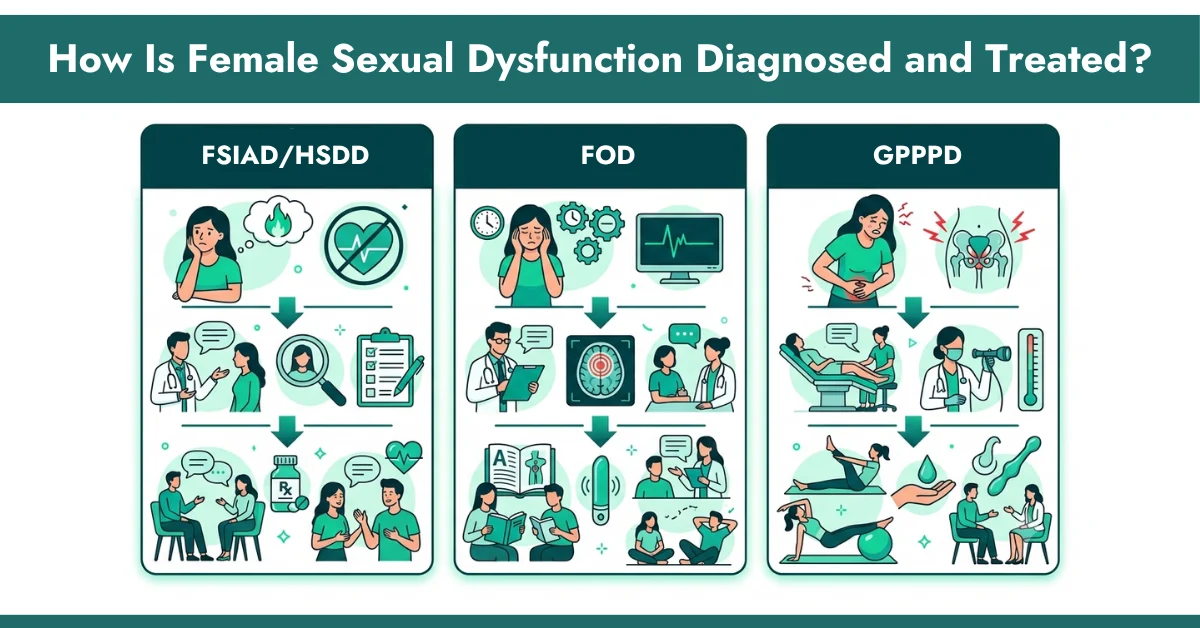
How Is Female Sexual Dysfunction Diagnosed and Treated?
Diagnosis starts with a conversation, not a lab test. A doctor rules out physical causes, reviews current medications, and asks how long the problem has lasted and how distressing it is.
Treatment depends on the type and the cause:
- FSIAD/HSDD: Flibanserin (Addyi) and bremelanotide (Vyleesi) are FDA-approved specifically for this diagnosis. Flibanserin’s approval expanded to postmenopausal women under 65 in December 2025, after a decade of covering only premenopausal women. Its own FDA label already flags CYP2C19, CYP2D6, and CYP2C9 as genes that change how much of the drug reaches the bloodstream, with slow metabolizers facing a real fainting risk.
- FOD: Sex therapy, adjusting the type of stimulation, or addressing a medication cause.
- GPPPD: Pelvic floor physical therapy, vaginal estrogen where menopause is the driver, counseling where fear or past trauma plays a role.
One thing worth knowing before assuming something’s wrong: research surveying more than 1,000 women found only about 18% can reliably orgasm through vaginal penetration alone. The rest need or rely on clitoral stimulation too. That’s anatomy, not dysfunction.
How Does Genetic Testing Fit Into Treatment?
If a current medication, an antidepressant especially, is the likely cause, pharmacogenomic (PGx) testing shows how your specific body processes that drug. It doesn’t diagnose FSD on its own, but it gives a prescriber data instead of a guess.
RPh Labs’ at-home PGx kit checks how your genes interact with 240+ medications, common SSRIs included, from a single cheek swab. Results arrive through a secure online portal in 7-10 business days, alongside support from a clinical pharmacist to walk through what it means. In a large multi-drug clinical trial that included antidepressants, genotype-guided prescribing cut adverse drug reactions needing medical attention by roughly 30%. The kit is HSA/FSA eligible, and it doesn’t replace a prescriber’s judgment. Coverage and state availability vary, so check current details before ordering.
Conclusion:
Female sexual dysfunction is common and often linked to hormones, medications, menopause, mental health, or underlying medical conditions. Identifying the cause is the first step toward the right treatment.
If symptoms began after starting a medication, PGx testing may help your healthcare provider make more informed prescribing decisions. Persistent symptoms deserve medical attention; they aren’t something you have to live with.
Disclaimer:
This content is for educational purposes only and is not medical advice. Always consult a qualified healthcare professional before making changes to your treatment or medications. PGx testing supports medication decisions but does not diagnose female sexual dysfunction.
Frequently Asked Questions
Yes. Roughly 4 in 10 women report some form of sexual difficulty at some point in their life, though a smaller share meet the full criteria for a diagnosable disorder, since ongoing distress is required.
HSDD (hypoactive sexual desire disorder) described low desire alone under the older DSM-IV system. The DSM-5 merged it with arousal problems into one diagnosis, FSIAD, though “HSDD” remains the term used on FDA drug labels like Addyi and Vyleesi.
Sometimes, though not always, and they can persist even after stopping the drug in some cases. A dose change, a different medication, or pharmacogenomic testing to find a better-matched option are all worth raising with a prescriber before stopping anything alone.
Coverage varies by plan. RPh Labs works with several major insurers and has a four-payment option with no added interest. Contact RPh Labs’ support team to confirm your specific coverage.
See a doctor if a symptom has lasted six months or longer, causes distress, or started shortly after a new prescription. A gynecologist, primary care provider, or urogynecologist can each evaluate FSD.
Leave a Reply