



You’ve tried ADHD medication that didn’t work. Side effects hit within days. Weeks passed, and sometimes months. And you’re still not sure if the next prescription will finally be the one that helps.
This cycle isn’t a personal failure; it is a biological problem. The FDA notes that genetic variation accounts for 20 to 95% of the difference in how people respond to the same medication. That’s not a small margin; it explains everything. What works brilliantly for someone else may do nothing for you, not because the drug is wrong, but because your biology processes it differently.
Genetic testing for ADHD medication changes this experience. A simple cheek swab analyzes how your body processes medications and helps your doctor make more informed decisions. While genetic testing offers valuable insights, current clinical evidence doesn’t show that it improves overall ADHD treatment outcomes enough to be recommended as routine care.
This guide covers everything you need to know how it works, what it can and can’t tell you, and how to choose the best option for your situation.
Why Does ADHD Medication Work Differently for Every Person?
ADHD medications, both stimulants and non-stimulants, work by influencing dopamine and norepinephrine activity in the brain. But before any drug reaches your brain, your liver has to process it first.
Your liver uses enzymes to break down medications. If those enzymes are too fast, the drug clears your body before it can work. If they’re too slow, it builds up and creates side effects. This metabolic speed is determined largely by your genes, and it varies significantly from person to person.
PMC Research shows that 30% of people with ADHD don’t respond to stimulants at all. That’s not a treatment failure. It’s a biology mismatch, one that a genetic test for ADHD medication is specifically designed to catch early.
However, while these genetic factors influence metabolism and side-effect profiles, no single genetic test has been shown to reliably pick the best medication for a person with ADHD.
What Does a DNA Test Actually Look for in ADHD Treatment?
A pharmacogenomic (PGx) test doesn’t look for “the ADHD gene.” It analyzes the genes responsible for how your body metabolizes and responds to specific medications.
The Key Genes That Shape Your Response:
- CYP2D6: Controls breakdown of atomoxetine and several amphetamine-based drugs. Poor metabolizers risk side effects. Rapid metabolizers may see little effect at standard doses.
- CYP2C19: Affects how some non-stimulants and co-prescribed psychiatric medications are processed.
- SLC6A3 (DAT1) and DRD4: Dopamine-related genes that influence how strongly your brain responds to stimulants like methylphenidate.
- COMT: Regulates dopamine clearance in the prefrontal cortex, which directly affects focus, impulse control, and medication sensitivity.
| Gene | Medications Affected | What It Reveals |
| CYP2D6 | Atomoxetine, amphetamines | Metabolism speed: side effects or efficacy risk. |
| CYP2C19 | Non-stimulants, antidepressants | Tolerability and drug clearance rates. |
| DAT1/DRD4 | Methylphenidate, stimulants | The brain’s dopamine response to stimulant drugs. |
| COMT | All dopamine-dependent medications | Prefrontal cortex sensitivity to medication. |
How Does a Pharmacogenomic Test Actually Work?
The process is straightforward. There’s no blood draw, no clinic visit, and no complicated preparation.
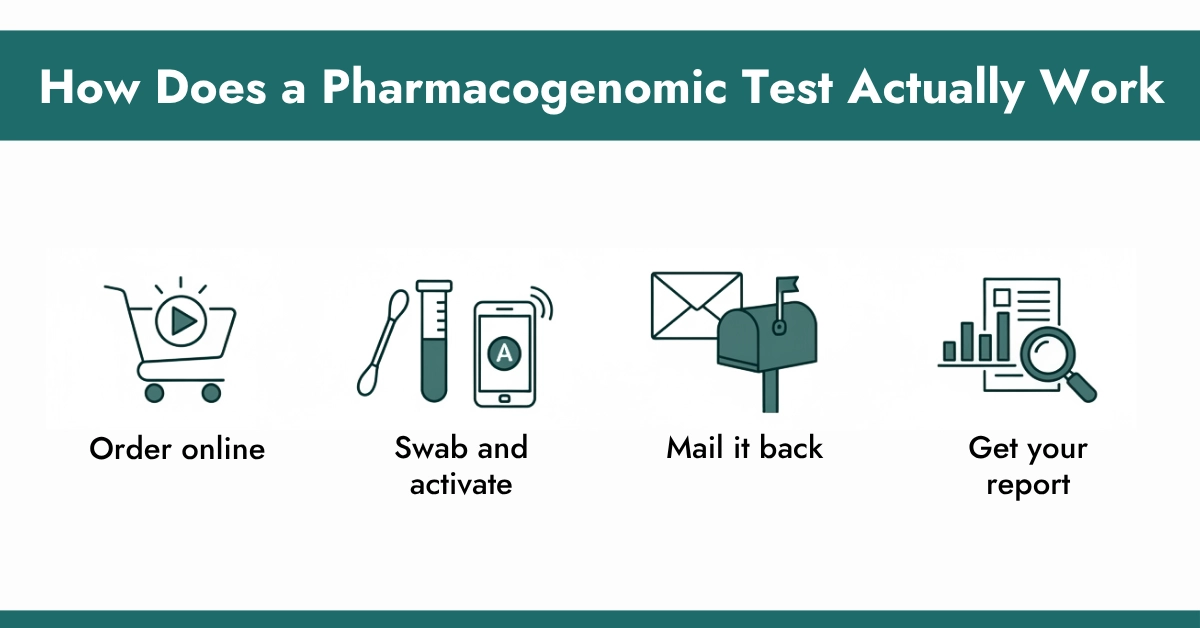
With the at-home PGx testing kit from RPh Labs, here’s exactly what happens:
- Order online: Your kit arrives directly at your door.
- Swab and activate: Collect a saliva sample with a cheek swab.
- Mail it back: A prepaid return envelope is included. No extra steps.
- Get your report: Within 7 to 10 business days, your personalized report appears on the RPh Labs portal.
The report provides clear, actionable insights on how your body may respond to 240+ medications covering not only ADHD drugs but also psychiatric pain and cardiovascular categories, making it a long-term medical reference tool. It’s also easy for parents and kids.
What Can a Genetic Test Tell You & What Can It Not?
What it can do:
- Identify whether you’re a slow, normal, or rapid drug metabolizer.
- Flag medications that may cause stronger side effects based on your genes.
- Help your doctor narrow down prescribed options faster.
- Reduce unnecessary medication switches and wasted time.
What it can’t do:
- Diagnose ADHD or any other condition.
- Guarantee a specific medication will work for you.
- Replace your doctor’s clinical judgment.
- Account for factors like age, sleep, diet, stress, or co-existing health conditions.
Being clear about these limits isn’t a weakness; it’s what makes the test trustworthy. It’s a powerful guide, not a magical answer.
Who Gets the Most Out of DNA-Based Medication Testing?
This isn’t only for people who’ve already tried and failed multiple medications, though it’s especially valuable there.
You’re a Strong Candidate If:
- You’ve tried two or more ADHD medications without satisfactory results.
- Side effects have forced you to stop medication early.
- You’re starting treatment and want to avoid the trial-and-error cycle from the beginning.
- You take other medications and need to check for potential interactions.
- You’re a parent managing a child’s ADHD treatment and want more informed choices earlier.
According to the Psychiatric Times, pharmacogenomic testing delivers the most impact in complex psychiatric cases where standard prescribing hasn’t worked. With at-home access now available, the barrier to getting tested has never been lower.
How Do You Use the Results With Your Doctor?
Receiving your results doesn’t mean changing your medication on your own. Here’s how to put them to work effectively:
- Share the full report with your prescribed doctor or psychiatrist at your next appointment.
- Ask directly about any medications flagged as “use with caution” or “consider alternatives.”
- Discuss dose adjustments if you’re already on a medication that shows a metabolism mismatch.
- Use the report as a starting point, not a final verdict.
RPh Labs reports are written to be doctor-friendly with clear action warnings, gene-specific notes, and suggested substitutes your provider can reference immediately.
Is the Best Genetic Testing for ADHD Medication Worth the Cost?
Factor in the cost of months of ineffective prescriptions, repeated appointments, missed work or school, and the emotional drain of treatment failure, and a single DNA test starts looking like a very smart investment.
RPh Labs’ CLIA-accredited PGx Testing Kit is priced at $299. It’s HSA and FSA eligible, meaning many patients can use pre-tax health savings to cover it. A zero-interest 4-installment payment plan is also available for those who prefer flexibility.
The test is CLIA licensure and COLA accreditation. The same quality standards are used in professional clinical settings. With 240+ medications, it’s not just a one-time answer. It’s a permanent reference for every medication decision from now on.
If the trial-and-error cycle has gone on long enough, your genes may finally give you a straight answer.
Conclusion:
Genetic testing for ADHD medication can help you understand how your body may process different drugs. It doesn’t promise a perfect answer or cure, but it can reduce guesswork and give your doctor useful information to make better treatment decisions. It works best when used with your symptoms, history, and your clinician’s expertise.
If you’re tired of trying one medication after another with mixed results, RPh Labs CLIA-accredited PGx testing kit can offer a clearer starting point. It gives genetic insights that support conversations with your doctor and helps tailor your treatment plan more thoughtfully. Order your kit today and bring your genetic results to your next appointment, because personalized care starts with understanding your body.
Disclaimer:
This information is educational and doesn’t replace professional medical advice. Genetic testing is not a diagnostic tool and shouldn’t be used alone to change medications. Always talk to your healthcare providers first. The usefulness of genetic testing can vary by individual, and results should be interpreted with the help of a clinician. Pictures in this article are created from AI tools just for illustrative purposes only.
Frequently Asked Question
Yes. The genes that influence how medications are metabolized don’t change with age. PGx testing applies to both children and adults. If your child has struggled with ADHD medications or experienced difficult side effects, DNA-based testing can help guide safer, more targeted options early in treatment.
Coverage depends on your plan. RPh Labs works with several insurance providers, including Medicare and Medicaid of Texas. For self-paying patients, the kit is $299, with a zero-interest 4-part payment plan. It’s also HSA and FSA-eligible, so pre-tax health savings accounts can be applied.
Pharmacogenomic testing is highly reliable for identifying your metabolizer status for specific drug pathways. However, no test predicts medication outcomes with complete certainty. Results should always be reviewed with your prescribing doctor alongside your full clinical history and current symptoms.
RPh Labs allows patients to order directly online without a referral. That said, having a licensed provider review your results is strongly recommended. The report is most useful when applied in a professional clinical context to your actual treatment decisions.
No. Your DNA doesn’t change. Once you receive your PGx results, they serve as a permanent reference for any future medication decisions, not just for ADHD.
Leave a Reply