




Some people are born with muscles that seem superhuman. Here’s why their DNA makes all the difference.
Myostatin-related muscle hypertrophy occurs when a mutation in the MSTN gene shuts down the body’s natural muscle-limiting protein. The result is significantly higher muscle mass, present from birth, requiring no training, no supplements.
According to MedlinePlus or NIH, affected individuals can carry up to twice the normal muscle mass with zero health complications.
Many people search for “Hercules gene in humans” or “myostatin deficiency in humans”, both describe this exact condition. This guide covers everything clearly, in one place.
What Is Myostatin-Related Muscle Hypertrophy?
Your body controls muscle growth using a protein called myostatin. It acts like a natural brake, telling muscles exactly when to stop growing.
Myostatin-related muscle hypertrophy happens when the body produces little or no myostatin. Without that signal, muscles grow far beyond normal limits, without any effort.
This is not a disease. It is a rare, benign genetic condition present from birth.
- Root cause: Mutation in the MSTN gene
- Main effect: Abnormally high skeletal muscle mass
- Also called: Myostatin deficiency, MSTN mutation, myostatin disorder
- Health risk: None confirmed in any documented case
MSTN Gene Explained: How Mutations Affect Muscle
The MSTN gene produces myostatin, part of the TGF-β protein family. Normally, myostatin slows muscle growth and encourages breakdown, keeping muscle mass energy efficient.
When a mutation occurs:
- Myostatin production is reduced or ineffective
- Muscles grow unchecked
- Both muscle growth regulation and the breakdown process are disrupted.
This mechanism explains why myostatin-related muscular hypertrophy can produce dramatically larger muscles without health consequences.
Homozygous vs. Heterozygous: Does It Make a Difference?
Yes, significantly.
- A homozygous MSTN mutation means both gene copies are affected. This produces the most extreme myostatin deficiency symptoms in humans; muscle mass can reach twice the normal level. The first confirmed human case, a German boy in 2004, had this type.
- A heterozygous MSTN mutation means only one copy is affected. Muscle growth is still above average, but noticeably less extreme. The same boy’s mother, a former professional athlete, was heterozygous.
Important:
Larger muscles do not automatically mean stronger muscles. A myostatin mutation increases muscle volume but does not always increase the force individual muscle fibers produce. Size and strength are genuinely different measurements.
The First Human with the Hercules Gene: A Real Story
Can humans actually have myostatin deficiency? Yes, and it is fully documented.
- The first confirmed case of human myostatin deficiency was published in the New England Journal of Medicine in 2004. A German infant was born with visibly enlarged muscles in his thighs and arms.
By age four, he could hold two 3-kg dumbbells with arms fully extended horizontally, something most adults cannot do. His heart, brain, and all organ systems were completely normal. - A second case emerged in the United States in 2005. That child showed extreme muscle growth through a different mechanism. His body produced normal myostatin, but his cells could not respond to it due to a receptor defect.
Is this a disorder or an advantage? Medically, it is a condition, not a disorder. It causes no pain, no illness, and no limitations on daily life. Many researchers consider it a rare natural biological variation.
Common myth cleared up:
Extreme muscularity is often assumed to involve steroids. A myostatin mutation in humans is a completely natural genetic event, entirely unrelated to any substance.
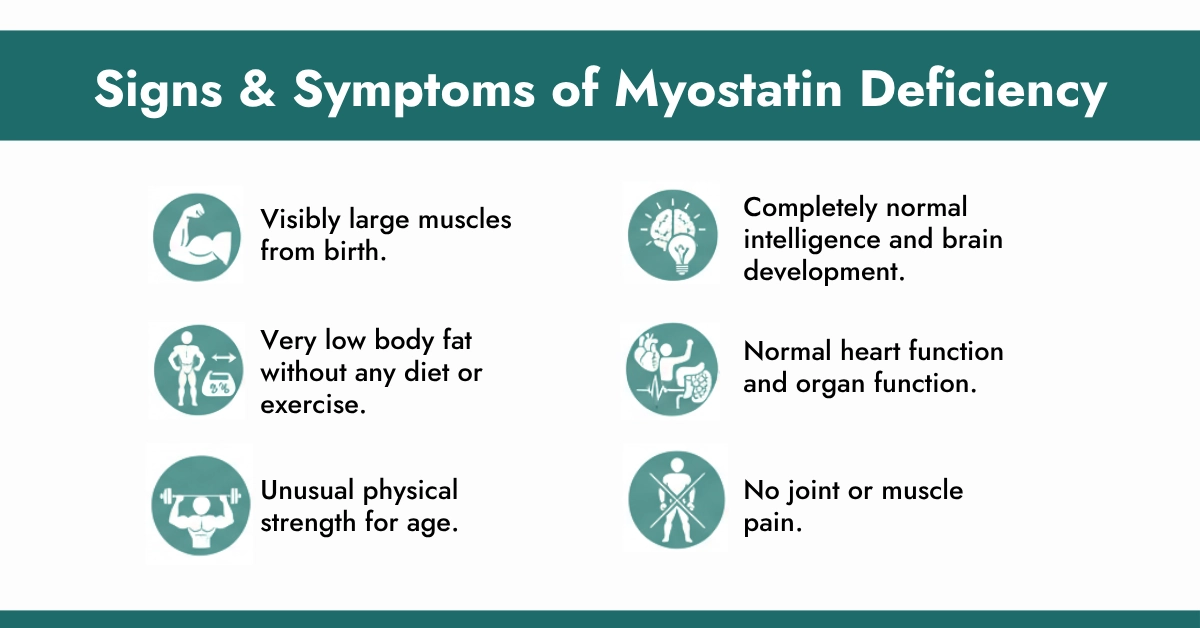
Signs & Symptoms to Look For:
Does myostatin deficiency affect daily activities? In most documented cases, not at all. Signs appear early, usually at birth or in early childhood, but cause no functional limitations.
The effects of the Hercules gene in daily life include:
- Visibly large muscles from birth.
- Very low body fat without any diet or exercise.
- Unusual physical strength for age.
- Completely normal intelligence and brain development.
- Normal heart function and organ function.
- No joint or muscle pain.
These signs alone cannot confirm the condition. Only a genetic test for the MSTN gene mutation can provide a definitive answer.
How Is Myostatin-Related Muscle Hypertrophy Diagnosed?
Diagnosis follows two clear, straightforward steps.
1. Physical Assessment
Doctors measure muscle size and body fat using ultrasound, DEXA scan, or MRI. This confirms the physical abnormality and rules out other causes before genetic testing begins.
2. How to Test for the MSTN Gene Mutation
The only definitive confirmation comes from MSTN gene testing. The MSTN gene is the sole gene currently linked to this condition.
Testing uses next-generation sequencing (NGS), achieving over 99% sensitivity, to identify sequence variants within the gene. A blood sample, saliva, or a simple cheek swab is all that is required.
For people wanting a broader view of their genetic health, pharmacogenomics (PGx) testing is worth exploring. RPh Labs offers a CLIA-accredited PGx testing kit that reveals how your genetic makeup affects your body’s response to 250+ medications, delivered to your door with results in 7 to 10 business days. It works on the same core principle, understanding your DNA to make smarter, more confident health decisions.
Is There a Treatment for Myostatin-related Muscle Hypertrophy?
No treatment is needed. The condition is completely harmless. People with myostatin deficiency live fully normal lives without any medical intervention required.
However, scientists are actively researching myostatin inhibitors, not for this condition, but for the opposite problem. Muscle-wasting diseases like Duchenne muscular dystrophy, sarcopenia, and cancer-related muscle loss are the real targets.
The goal is to artificially replicate the effects of the MSTN gene mutation, thereby rebuilding muscle in patients who are rapidly losing it. This makes the condition scientifically invaluable as a living human model for muscle-regulation research.
Athletic Performance & Genetic Variation:
How rare is the Hercules gene in competitive sport? Rarer than most assume, but research from PMC (PubMed Central) confirms MSTN gene variants appear more frequently in elite athletes than in the general population.
- Endurance athletes were 2x more likely to carry a specific MSTN deletion variant.
- Strength athletes showed higher rates of a particular MSTN gene mutation type.
- Findings differ across ethnic groups; no single rule applies universally.
Are myostatin inhibitors banned in sport?
Yes, WADA explicitly bans them. But athletes born with a natural MSTN gene mutation face zero sanctions. It is a genetic condition from birth, not a substance. The debate mirrors other natural genetic advantages like exceptional VO2 max or rare tendon elasticity.
Conclusion:
Myostatin-related muscle hypertrophy is a rare, benign genetic condition caused by MSTN gene mutations that allow muscles to grow beyond normal limits. While extremely rare, it poses no health risks and offers valuable insight into human genetics and muscle regulation.
Understanding this condition can inform both medical research and athletic performance studies.
While RPh Labs specializes in CLIA-accredited PGx testing, which provides insights into how your body responds to medications, understanding your genetics in general empowers smarter health decisions and personalized care.
Disclaimer:
This information is meant for general understanding and is not medical advice. Always check with a healthcare professional for any personal health questions. Results may vary for individuals. The images shown in this blog are AI-generated just to give you information.
Frequently Asked Questions
Their muscles grow far beyond normal limits from birth. The condition is called myostatin-related muscle hypertrophy. It causes no health complications, no pain, and no impact on intelligence or heart function whatsoever.
Yes, confirmed and medically documented. The first case appeared in the New England Journal of Medicine in 2004. Multiple cases have been identified worldwide. It is extremely rare but fully verified.
Not automatically. Muscles become larger in size, but research shows that muscle force output does not always increase proportionately. Size and functional strength are genuinely different measurements. Most sources skip this distinction entirely.
Yes. It follows an incomplete autosomal dominant pattern. One mutated copy from one parent still produces above-average muscle growth. Two mutated copies, one from each parent, produce far more dramatic results from birth.
The main effects include significantly enlarged muscles from birth, very low body fat, and above-average physical strength. Intelligence, heart function, and overall health remain completely normal. It is a physical genetic variation, not a medical condition requiring treatment.
Training can enhance the existing muscle base, but it cannot change the genetic mutation itself. People with myostatin deficiency who exercise may develop even more pronounced muscularity. However, the core genetic condition remains unchanged regardless of lifestyle choices.
No confirmed risks exist in the current medical literature. All documented cases of MSTN gene mutation in humans show normal organ function, normal heart health, and normal lifespan expectations. The condition is classified as benign, meaning it causes no known harm to the body.
Leave a Reply