



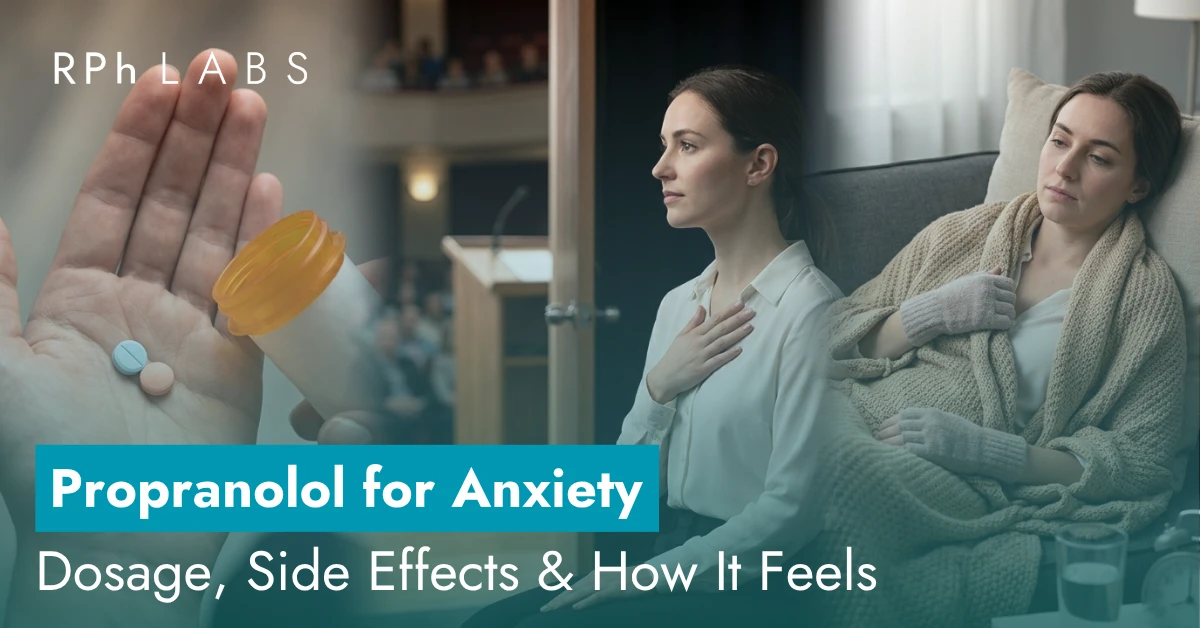
A racing heart before a presentation. Shaky hands during a performance review. A flushed face the moment you walk into a crowded room. If anxiety shows up physically before it takes over your thoughts, propranolol may be worth understanding.
This guide explains how propranolol works, who it helps, how long it lasts, what it feels like, common side effects, alcohol and drug interactions, sleep and gym effects, and why genetics can change your response. It is written to help readers make a more informed decision and know when to speak with a healthcare professional.
What Is Propranolol & Why Is It Used for Anxiety?
Propranolol is a non-selective beta-adrenergic receptor blocker, a beta-blocker, originally FDA-approved in 1967 for cardiovascular conditions including high blood pressure, angina, and irregular heart rhythms.
Its use for anxiety is off-label, meaning the FDA has not approved it for anxiety disorders.
Why is it popular:
- Works fast (30-60 minutes).
- Non-addictive.
- Widely available and inexpensive.
- Targets physical symptoms without sedating the mind.
Unlike SSRIs or SNRIs, propranolol does not change brain chemistry, mood, or emotional processing. It targets the body’s stress response, not the mind itself.
How Does Propranolol Work for Anxiety Symptoms?
Propranolol blocks beta-adrenergic receptors in the heart, blood vessels, and lungs. This prevents adrenaline (epinephrine) and noradrenaline (norepinephrine) from triggering the body’s fight-or-flight response.
In practical terms:
- Heart rate slows.
- Blood pressure drops.
- Tremors diminish.
- Sweating and flushing decrease.
The critical insight:
Propranolol breaks the physical feedback loop of anxiety. When your heart pounds and your hands shake, those sensations intensify fear. By muting those signals, propranolol can interrupt the spiral, even without touching your thoughts, worries, or emotions at all.
This is also its key limitation. It does not reduce worry, dread, catastrophic thinking, or the psychological core of anxiety disorders.
What Types of Anxiety Does Propranolol Actually Help?
Propranolol works best for situational and performance-based anxiety where physical symptoms are the primary problem.
Works best for:
- Performance anxiety (public speaking, interviews, exams).
- Social anxiety with physical symptoms.
- Situational anxiety (flying, presentations, meetings).
Less effective for:
- Generalized Anxiety Disorder (GAD).
- Panic disorder (psychological trigger-heavy).
- PTSD (not first-line treatment).
The bottom line:
- If anxiety is physical + situational: Propranolol helps.
- If anxiety is constant + cognitive: Other treatments work better (CBT, SSRIs).

What Does Propranolol Feel Like?
Most people describe propranolol as a physical calming effect without emotional sedation.
Common experiences:
- Heart feels “quiet”.
- Less shaking or trembling.
- Reduced physical urgency.
- Still aware of anxiety mentally.
Important distinction:
Propranolol doesn’t usually make you feel emotionally calm.
How Long Does Propranolol Last for Anxiety?
Duration depends on formulation.
Immediate-release (most common for anxiety):
- Onset: 30-60 minutes.
- Peak: 1-2 hours.
- Duration: 3-6 hours.
Extended-release:
- Duration: up to 24 hours.
Elimination:
- Fully eliminated in ~1-2 days.
- Half-life: 3-6 hours.
Practical takeaway:
It is a short-term situational medication, not a long-acting anxiety cure.
What Is the Right Propranolol Dosage for Anxiety?
Dosing varies by person, situation, and anxiety intensity. There is no universally “correct” dose, and this is where most online discussions go wrong.
| Situation | Typical Dose | When to Take |
| Performance anxiety | 10-40 mg | 30-60 min before the event |
| Social anxiety | 10-20 mg | 30 minutes before the trigger |
| Daily use (rare for anxiety) | Up to 60 mg/day | As prescribed |
Three most important things:
- Always trial before real events.
- Take consistently (food or no food).
- Extended-release capsules exist for symptoms.
What Are the Side Effects & Who Should Avoid It?
At low doses, most people tolerate propranolol well.
Common side effects:
- Fatigue and mild drowsiness.
- Cold hands and feet.
- Slightly lower blood pressure.
- Slower resting heart rate (bradycardia).
- Vivid dreams or mild sleep disruption.
Avoid or use caution if you have:
- Asthma or COPD (risk of bronchospasm).
- Diabetes (masks low blood sugar symptoms).
- Low blood pressure (hypotension).
- Heart conduction issues.
- Kidney or liver disease.
- Pregnancy (require supervision).
Safety Note:
Do not stop propranolol abruptly if you have been taking it regularly. Stopping suddenly can cause rebound heart rate acceleration and, in people with underlying heart conditions, can trigger serious cardiac events.
Can You Drink Alcohol With Propranolol?
Short answer: Not recommended
Alcohol + propranolol can cause:
- Lower blood pressure.
- Increased dizziness.
- Lightheadedness.
- Fainting risk in some cases.
- Increased fatigue.
Why this happens:
Both slow down cardiovascular responses and amplify each other’s effects unpredictably.
Does Propranolol Affect Sleep, Gym Performance, or Energy?
Sleep effects:
- Vivid dreams in some people.
- Mild sleep disruption.
- Occasional insomnia or fatigue.
Gym/exercise:
- Reduced maximum heart rate response.
- Lower exercise tolerance at higher doses.
- Feels hard to push physically.
Energy levels:
- Fatigue is common.
- Mild sluggishness possible.
- Dose-dependent effect.
Important:
It doesn’t directly sedate the brain, but it slows physical stimulation systems.
Can You Take Propranolol With Caffeine, SSRIs, or Stimulants?
Caffeine:
- May counteract calming physical effects.
- Can re-trigger palpitations.
- Reduces perceived benefit in some users.
SSRIs (antidepressants):
- Generally safe under medical supervision.
- Common combination in anxiety treatment.
Stimulants (ADHD meds like amphetamines):
- Opposing effects on heart rate.
- Requires medical supervision.
- Can mask or complicate physical signals.
Does Propranolol Work the Same for Everyone? (Genetic Factor)
No, response varies significantly based on genetics. Your genetic makeup directly determines how your body processes propranolol. The drug is metabolized primarily by two liver enzymes in the cytochrome P450 family: CYP2D6 and CYP2C19.
Genetic types:
- Poor metabolizer.
- Extensive (normal) metabolizer.
- Ultra-rapid metabolizer.
Research published in the British Journal of Pharmacology found that propranolol itself inhibits CYP2D6, meaning the drug can actually slow its own metabolism over time and can interfere with other medications processed by the same enzyme, including many antidepressants and antipsychotics.
Why this matters: Two people take the same 20 mg dose. One feels calm and slightly fatigued. The other notices nothing at all. Neither is “wrong”; they simply have different metabolizer profiles. Without knowing which type you are, prescribing and dosing becomes trial and error.
This is exactly where pharmacogenomic (PGx) testing becomes clinically valuable. RPh Labs offers a CLIA-accredited, at-home PGx test that analyzes the key genes affecting your response to 240+ medications. It requires only a simple cheek swab, no clinic visit, and results are delivered to the RPh Labs portal within 7-10 business days, in a format you can actually share with your prescriber to make smarter, faster decisions. If you’ve ever felt like a medication worked differently than expected, your genetics may be the reason.
Can Propranolol Be Used With Therapy or Other Treatments?
Yes, and this is one of its strongest uses.
Propranolol + Cognitive Behavioral Therapy (CBT) is a well-supported pairing.
- CBT: Changes thoughts and avoidance behavior.
- Propranolol: Reduces physical anxiety symptoms.
Together they target both:
- Mind (psychological triggers).
- Body (physical reactions).
Drug interaction warnings:
- MAOIs (a class of antidepressants): Combining with propranolol can cause dangerous blood pressure fluctuations.
- Other antihypertensives: Additive blood pressure lowering can be hazardous.
- Calcium channel blockers: Can compound the effect on heart rate and conduction.
- Alcohol: Increases sedation and blood pressure-lowering effects; avoid combining.
Always inform your doctor about all medications.
Conclusion:
Propranolol is a fast-acting, non-addictive medication that helps reduce the physical symptoms of anxiety. It is especially useful for performance and situational anxiety, where racing heart, tremor, and sweating are the main issues.
But it has limits. It doesn’t treat the root emotional causes of anxiety, and response can vary because of genetics, other medications, alcohol, and underlying health conditions. For people who need more personalized prescribing, RPh Labs CLIA-accredited PGx testing can support smarter medication decisions with a simple at-home cheek swab.
Disclaimer:
This article is for educational purposes only and doesn’t constitute medical advice. Propranolol is a prescription medication. Always consult a licensed healthcare provider before starting, stopping, or adjusting any medication. Images in this article are created from AI tools.
Leave a Reply