



Most people don’t feel better on their first psychiatric medication. STAR*D, the largest real-world antidepressant study on record, found that only about 37% of participants reached remission on their first medication trial, and many needed a second or third drug before symptoms eased.
Genetic testing for psychiatric medications, also called pharmacogenetic or PGx testing, looks at specific genes tied to how your body breaks down antidepressants, antipsychotics, ADHD drugs, and mood stabilizers. A cheek swab won’t name the one drug guaranteed to work, but it can flag which ones your liver enzymes may struggle to clear at a standard dose. Here’s what current research actually backs, where it falls short, and how the swab-to-results process works at a CLIA- and COLA-accredited lab like RPh Labs.
What Is Genetic Testing for Psychiatric Medications?
Genetic testing for psychiatric medications is a lab test, usually run from a cheek swab, that checks specific genes tied to how your body absorbs, breaks down, and clears psychiatric drugs. It doesn’t diagnose depression, ADHD, bipolar disorder, or any other condition. It only shows how your metabolism handles the medications used to treat those conditions.
Two terms get used almost interchangeably here: Pharmacogenetics, which looks at one or a few genes, and pharmacogenomics, which looks at a wider set across the genome. Most consumer psychiatric panels, including RPh Labs’ at-home PGx kit, sit closer to the pharmacogenetics end, since they check a defined list of genes tied to known drug interactions rather than sequencing your entire genome.
Identifying metabolic phenotypes
The test classifies you into four main categories:
- Poor Metabolizer: You break down drugs very slowly, leading to high side-effect risks.
- Intermediate Metabolizer: You have a slightly reduced capacity to process medications.
- Normal Metabolizer: Your body processes drugs at the expected rate.
- Ultra-Rapid Metabolizer: You clear drugs so fast they may never work.
How Does Psychiatric PGx Testing Work?
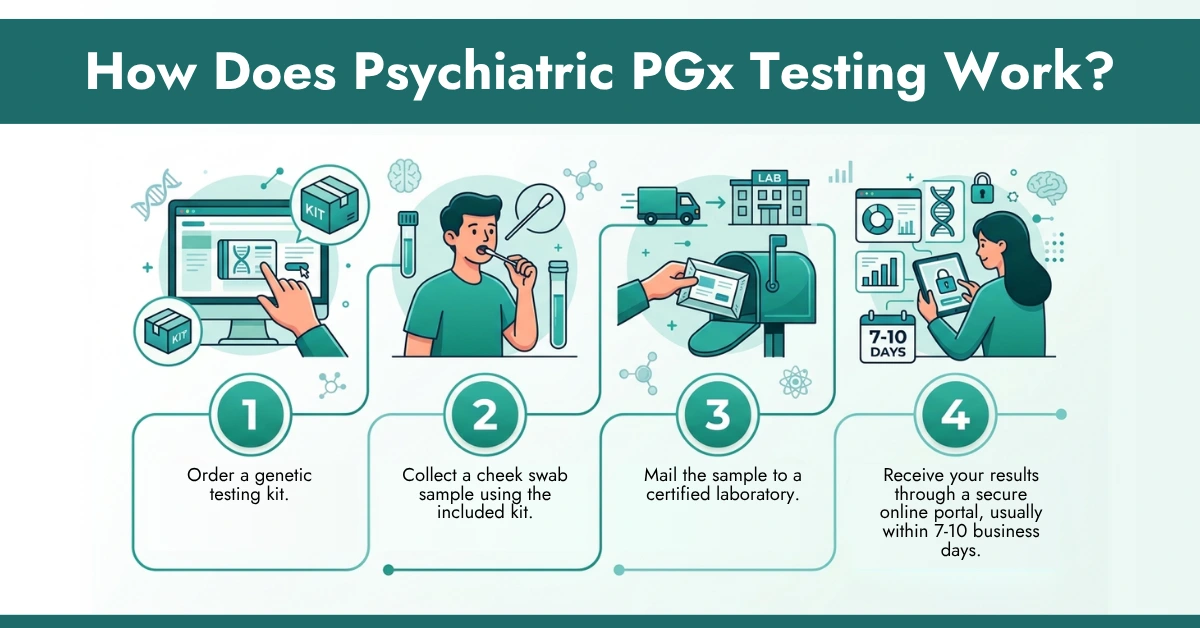
Most modern psychiatric PGx tests use a painless cheek swab instead of a blood sample. The process is simple and can often be completed from home.
The typical testing process includes:
- Order a genetic testing kit.
- Collect a cheek swab sample using the included kit.
- Mail the sample to a certified laboratory.
- Receive your results through a secure online portal, usually within 7-10 business days.
Laboratories analyze selected genes associated with psychiatric medication metabolism rather than sequencing your entire genome. Your healthcare provider reviews the report alongside your medical history, symptoms, current medications, and previous treatment response before making any medication changes.
PGx testing should always be considered one part of a comprehensive treatment plan, not a replacement for clinical evaluation.
Which Psychiatric Medications and Conditions Does It Cover?
PGx panels built for mental health typically cover antidepressants (SSRIs and SNRIs), antipsychotics, ADHD medications, and several mood stabilizers used for bipolar disorder and OCD. RPh Labs’ panel checks 240+ medications total, with a dedicated mental health category that includes citalopram, fluoxetine, and paroxetine, among others.
- Depression and anxiety: SSRIs like citalopram, paroxetine, and other serotonin-based antidepressants are metabolized largely through CYP2D6 and CYP2C19. Testing flags whether you’re likely to clear a standard dose too slowly or too fast, and by how much.
- ADHD: Atomoxetine (Strattera) interacts with CYP2D6, and its FDA label recommends a lower starting dose for CYP2D6 poor metabolizers. If you’re considering testing, confirm that your medication is included on the panel.
- Bipolar disorder and OCD: Testing here leans more on HLA genes, which flag a risk of serious skin reactions to mood stabilizers like carbamazepine, rather than predicting which mood stabilizer works best for you.
Which Genes Actually Drive Psychiatric Drug Response?
Two liver enzymes, CYP2D6 and CYP2C19, do most of the work. Together they metabolize a large share of antidepressants, antipsychotics, and ADHD medications, making your metabolizer status one of the most useful pieces of information a psychiatric PGx report provides.
| Gene | What It Affects | Psychiatric Medication Examples |
| CYP2D6 | Metabolizes roughly 1 in 4 prescription drugs; status ranges from poor to ultra-rapid metabolizer | SSRIs and SNRIs, several antipsychotics, atomoxetine (ADHD) |
| CYP2C19 | Affects blood levels of specific SSRIs | Citalopram and related antidepressants |
| SLC6A4 | Serotonin transporter gene tied to variable SSRI response | SSRIs |
| HTR2A | Linked to SSRI side-effect risk | SSRIs |
| HLA-B/HLA-A | Flags risk of serious hypersensitivity or skin reactions | Carbamazepine and related mood stabilizers |
The Clinical Pharmacogenetics Implementation Consortium (CPIC) and the FDA’s Table of Pharmacogenomic Biomarkers in Drug Labeling both publish the gene-drug pairs with enough data behind them to act on. RPh Labs’ full medication list notes the CPIC level and FDA label status for each drug it covers.
How Accurate Is Psychiatric Genetic Testing?
Genetic testing is reliable for predicting how fast your body clears certain medications and whether you may have a higher risk of side effects at standard doses. However, it cannot predict the single psychiatric medication that will work best for you.
The FDA and the Clinical Pharmacogenetics Implementation Consortium (CPIC) recognize specific gene-drug pairs with sufficient evidence to support prescribing decisions. Clinical studies also suggest that PGx testing can help reduce trial-and-error prescribing for some patients by identifying medications with potential gene-drug interactions.
The bottom line: A psychiatric PGx report is one data point your prescriber uses alongside your symptoms, medical history, and previous treatment response, not a test that chooses your medication.
Is Genetic Testing for Psychiatric Medications Covered by Insurance?
Coverage depends on your insurance plan and how the test is ordered. Many insurers require a healthcare provider to order the test and document a medical need before approving coverage.
If insurance doesn’t cover the test, many laboratories offer self-pay options, and some accept HSA/FSA funds. Before ordering, check with both your insurance provider and the testing laboratory to confirm eligibility and costs. RPh Labs works with several plans, including Medicaid of Texas, Blue Cross Blue Shield of Texas, and Baylor Scott & White, and lists current accepted plans on its insurance coverage page. Eligibility still varies by plan, so it’s worth a quick check before you order.
Who Should Consider PGx Testing for Mental Health Medications?
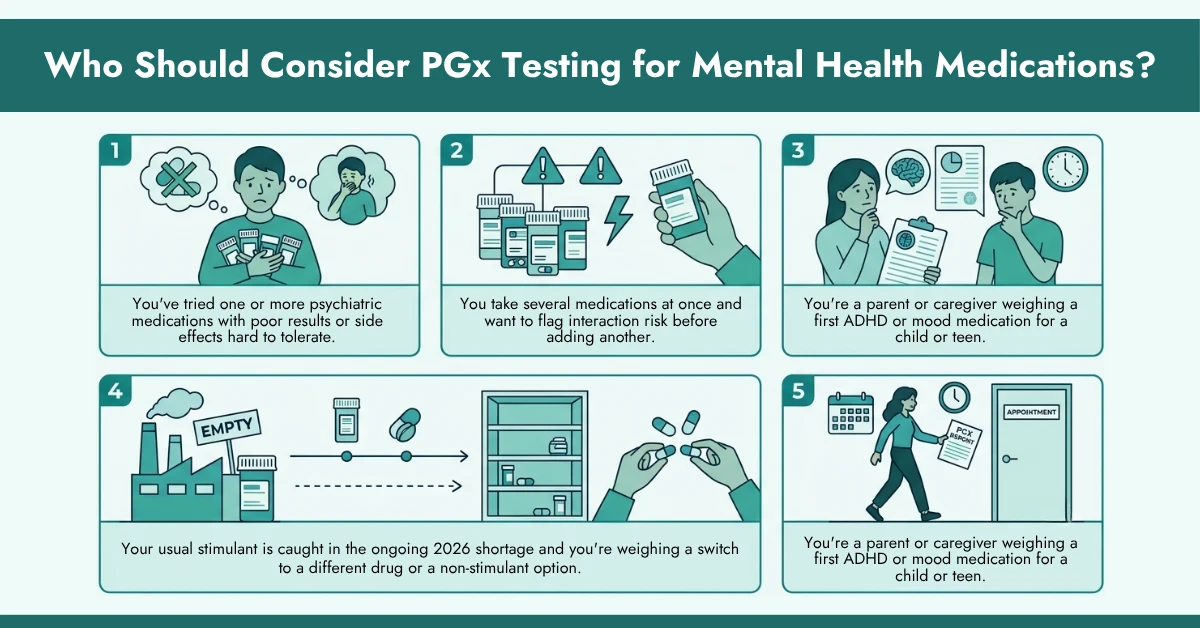
PGx (Pharmacogenomic) testing is often most helpful for people who have experienced poor results or significant side effects from one or more psychiatric medications.
Consider it if:
- You’ve tried one or more psychiatric medications with poor results or side effects hard to tolerate.
- You take several medications at once and want to flag interaction risk before adding another.
- You’re a parent or caregiver weighing a first ADHD or mood medication for a child or teen.
- Your usual stimulant is caught in the ongoing 2026 shortage and you’re weighing a switch to a different drug or a non-stimulant option.
- You want something concrete to bring to your next appointment, not a replacement for one.
Not every prescriber has formal training in reading a PGx report yet. Recent surveys of mental health clinicians point to real gaps in pharmacogenomics education, which is part of why RPh Labs writes its reports with plain-language flags for each medication rather than raw genotype codes alone. NAMI’s overview of pharmacogenomic testing is a solid independent read if you want a second, non-commercial source before you decide.
RPh Labs currently reaches 45 states. If you’re in New York, California, Maryland, Pennsylvania, or Rhode Island, check the current coverage map, since that list keeps expanding.
Conclusion:
A psychiatric PGx test helps explain how your body may process certain medications; it doesn’t determine which medication is right for you. If you’ve cycled through more than one antidepressant, ADHD medication, or mood stabilizer without much luck, a swab and a 7-10-day wait is a low-effort way to bring real information to your next appointment instead of another guess.
Order your PGx kit, check which medications RPh Labs tests for, or see if RPh Labs reaches your state. You can also find RPh Labs on Facebook and Instagram for updates as new medications and states are added.
Disclaimer:
This article is educational and isn’t a substitute for individualized medical or genetic counseling advice. Talk to your prescriber or a genetic counselor before making any medication changes. Drug coverage, gene-drug evidence, and state availability shift often.
Frequently Asked Questions
No. It only shows how your body metabolizes medications used to treat conditions like depression, anxiety, ADHD, and bipolar disorder. Diagnosis still comes from a clinical evaluation with a psychiatrist or other prescriber.
No. Most tests, including RPh Labs’ kit, use a cheek swab. Blood draws show up more in other specialties, like warfarin dosing, but saliva carries enough DNA for a full psychiatric panel.
Most labs return results within 7-10 business days of receiving your sample, delivered through a secure online portal rather than by phone or mail.
Some at-home kits, including RPh Labs’, can be self-ordered. For insurance reimbursement, though, most plans still want the test ordered by your prescribing doctor with documentation of a gene-drug concern.
Single-gene testing checks one well-studied gene, like CYP2D6, against CPIC and FDA guidance. Combinatorial panels run a proprietary algorithm across many genes at once to produce a ranked list of medications; that ranking is the part regulators and researchers have pushed back on hardest.
Leave a Reply